EuroDaily News and Guidance, Every Day

Related Articles



The CERN rare particle decay discovery search has spanned more than 40 years — and physicists at CERN have now found the first evidence of the rarest particle decay ever seen at the Large Hadron Collider. The international LHCb collaboration announced on 3 November that it had found evidence of a beauty particle decaying into two muons, a process predicted to occur only around once in every 10 billion beauty particles. The result opens a new window on the smallest distances in nature, a realm physicists call the "Zeptoverse".
The decay, known as "Bd to mu mu", involves a particle containing a beauty quark, a heavier relative of the up and down quarks that make up much of the matter around us. Beauty quarks are produced in huge numbers in collisions at the Large Hadron Collider, but they exist for only around one and a half trillionths of a second before decaying. The new result concerns one particular way they can decay: into two muons, heavier relatives of the electron. Scientists have been looking for it since the early 1980s.
Evidence, not yet a discovery
The result has a statistical significance of 3.2 sigma, which is enough for physicists to describe it as the first evidence of the decay, but below the five-sigma threshold required to claim a discovery in particle physics. Further data will be needed before the CERN rare particle decay discovery can be declared, and the upgraded LHCb experiment is expected to collect a much larger data set into the early 2030s, allowing scientists to study it with increasing precision.
The analysis also produced the most precise measurements yet of another rare beauty-particle decay, known as "Bs to mu mu", which was first observed by LHCb in 2015. That measurement, like the new one, agrees with the Standard Model, the theory that describes the known particles and forces. The result does not reveal a new particle or contradict existing theory. Its importance lies in the precision it makes possible: by measuring such a rare process so accurately, physicists can probe for the faint effects of particles too heavy or too weakly interacting to be seen directly.
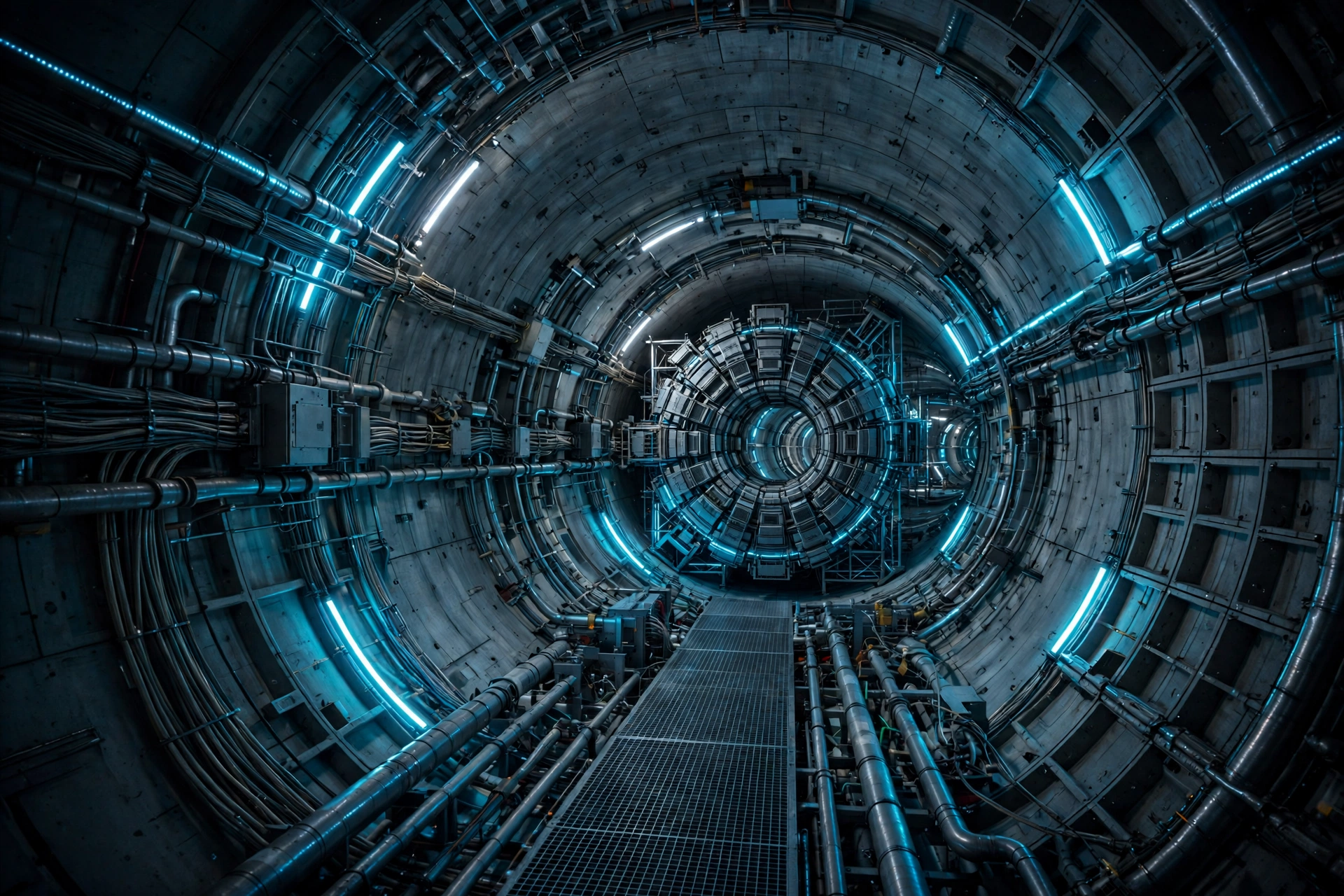
CERN rare particle decay discovery: the machine that made it possible
The finding was made possible by the upgraded LHCb experiment, which began collecting data in 2024 and can now record collisions at up to five times its previous rate, giving scientists a much larger sample of particles to study. At the heart of the upgrade is the Vertex Locator, known as VELO, a highly sophisticated silicon pixel detector that sits just five millimetres from the LHC beams and forms the first layer of the experiment's particle-tracking system. It was assembled by researchers at the University of Liverpool.
The team combined new data collected in 2024 and 2025 with data from earlier runs between 2011 and 2018. The new data alone produced evidence at three standard deviations; combining them with the earlier measurements raised the significance to 3.2 sigma, above the conventional evidence threshold but below discovery level.
The Zeptoverse
The result brings scientists closer to exploring what physicists call the Zeptoverse, a world of extraordinarily small distances, around a billionth of a trillionth of a metre, or a zeptometre, where previously undiscovered particles and forces of nature may be hiding. At such distances, the effects of new physics could show up as tiny deviations from the Standard Model's predictions in rare decays like this one.
The work was led by an international team, with British scientists playing a central role. Professor Chris Parkes, head of the Department of Physics and Astronomy at the University of Manchester, led the international LHCb collaboration through the construction of the upgrade and led the collaboration's approval of the new result. Dr Harry Cliff, of the University of Cambridge's Cavendish Laboratory, led the analysis team. The collaboration has submitted its analysis as a preprint to the journal Physical Review X, and the upgraded detector will keep collecting data for years. If the decay rate turns out to differ from the Standard Model's prediction, that would be the first sign of new physics.
Related: NASA Names Eight Firms for $10 Billion Moon Deliveries
Sources
https://news.liverpool.ac.uk/2026/11/03/university-of-liverpool-detector-helps-scientists-uncover-evidence-of-rarest-particle-decay-after-42-year-search/
https://www.manchester.ac.uk/about/news/manchester-physicists-step-closer-to-the-zeptoverse-after-42-year-particle-search/
https://www.physics.ox.ac.uk/news/evidence-rarest-particle-decay-after-42-year-search
Also visit our other websites: GulfCareers — Jobs in Dubai, UAE & Gulf | IndeedOne — Jobs and Information