

How to Get a Visa for Germany: A Complete Guide for USA Travelers
How to get a visa for Germany made simple. Follow 7 proven steps, learn fees, documents, and insider tips for smooth approval from the USA.
Dreaming of wandering through Berlin’s buzzing streets, sipping espresso in Munich’s old town, or cruising the Romantic Road like a postcard come alive? How to get a visa for Germany becomes the first real step toward that adventure. Fortunately, U.S. passport holders enjoy generous access to Germany, yet long stays and special purposes still require proper documentation.
At the heart of this journey sits Germany’s role in the Schengen Area, a collective of European nations that allow border-free travel. You can enter Germany visa-free for short stays up to 90 days within 180 days.
However, once plans stretch longer, or your purpose changes, the rules shift quickly. Think of it like borrowing a friend’s car. A short ride feels fine. A cross-country trip needs paperwork.
This guide walks you through every step of how to get a visa for Germany, tailored specifically for U.S. residents. You’ll learn eligibility rules, visa types, costs, timelines, required documents, and insider tips that keep rejection risks low. By the end, you’ll know exactly how to move forward with confidence.
Why Americans Travel to Germany So Often
Germany attracts American travelers for reasons that stretch far beyond Oktoberfest and fairy-tale castles. The country boasts Europe’s strongest economy, top universities, advanced medical facilities, and a culture that blends precision with creativity. Many U.S. citizens pursue business partnerships in Frankfurt, study engineering in Aachen, or reconnect with family roots in Bavaria.
Moreover, Germany offers seamless transportation. High-speed trains glide between cities. Airports connect globally. Digital infrastructure supports remote work lifestyles. These advantages make Germany a magnet for professionals, students, entrepreneurs, and retirees alike.
Understanding how to get a visa for Germany lets you unlock these opportunities without stress or last-minute surprises.
Do U.S. Citizens Need a Visa for Germany?
U.S. passport holders can enter Germany without a visa for tourism, business meetings, or family visits for up to 90 days within any 180-day period. Border officers stamp your passport upon entry, and the clock starts ticking automatically.
However, you must apply for a visa if you plan to:
- Work or freelance
- Study longer than 90 days
- Join family permanently
- Start a business
- Stay beyond the 90-day limit
Think of short visits as borrowing a library book. Long stays require membership. That’s where mastering how to get a visa for Germany becomes essential.
Official reference:
German Federal Foreign Office – https://www.auswaertiges-amt.de
Types of German Visas for U.S. Applicants
Choosing the right visa category saves time, money, and emotional energy. Each visa matches a specific purpose and documentation set.
1. Schengen Tourist Visa (Short Stay)
Best for travelers staying under 90 days for tourism, conferences, or family visits. Americans usually don’t need this unless special circumstances apply.
2. National Visa (Long Stay)
Required for stays exceeding 90 days. This category covers work, study, family reunion, and entrepreneurship.
3. Work Visa
Designed for professionals with a German job offer. Engineers, IT specialists, healthcare workers, and skilled trades often qualify.
4. Student Visa
Supports university enrollment, language programs, and academic research.
5. Freelance Visa
Ideal for digital nomads, artists, writers, and consultants serving German clients.
6. Family Reunion Visa
Allows spouses, children, and dependents to join residents or citizens in Germany.
Selecting the correct path directly influences approval speed and success when learning how to get a visa for Germany.
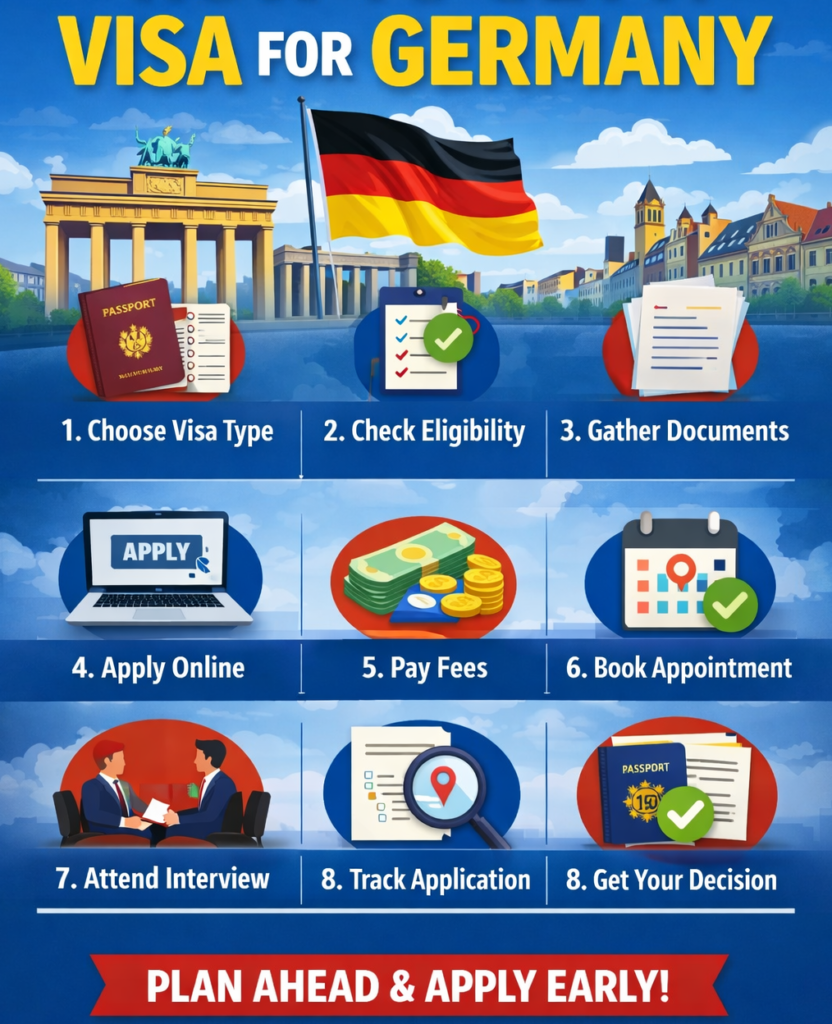
Step-by-Step Process: How to Get a Visa for Germany from the USA
Step 1: Identify Your Visa Type
Clarify your purpose honestly. Immigration officers look for consistency between documents and stated intent.
Step 2: Gather Required Documents
Common documents include:
- Valid U.S. passport (minimum six months validity)
- Completed visa application form
- Recent biometric photos
- Proof of accommodation
- Travel insurance coverage (€30,000 minimum)
- Financial proof (bank statements, sponsorship letter)
- Purpose-specific documents (job contract, university admission, marriage certificate)
Step 3: Schedule an Appointment
Book your appointment at the nearest German Consulate or Embassy:
- German Embassy Washington D.C. – https://www.germany.info
- Consulates in New York, Los Angeles, Chicago, Houston, Atlanta
Appointments fill quickly. Book early.
Step 4: Attend Your Interview
Bring originals and copies. Dress professionally. Answer clearly. Officers evaluate consistency, financial stability, and return intent.
Step 5: Pay the Visa Fee
Most national visas cost approximately €75, payable in USD equivalent.
Step 6: Track Processing
Processing takes 4–12 weeks depending on visa type and workload.
Step 7: Collect Your Passport
Once approved, collect your passport and prepare for travel.
This structured approach simplifies how to get a visa for Germany without unnecessary detours.
Financial Requirements for German Visas
Germany values financial stability. You must demonstrate that you can support yourself without burdening public systems.
Typical financial proof includes:
- Bank statements showing sufficient balance
- Blocked account (Sperrkonto) for students
- Employment contract with salary details
- Sponsor declaration (Verpflichtungserklärung)
Students usually need approximately €11,208 per year in a blocked account. Professionals rely on salary contracts.
Money talks. Clear documentation speaks louder.
Health Insurance Rules for Germany
Germany mandates health insurance for all residents. Travel insurance suffices for short stays. Long-term visas require German-compliant health insurance policies.
Recommended providers include:
- Mawista – https://www.mawista.com
- TK Health Insurance – https://www.tk.de
- Allianz Care – https://www.allianz-care.com
Insurance protects both your wallet and your peace of mind.
Common Reasons for Visa Rejection
Even strong applicants sometimes face denial. The most frequent causes include:
- Incomplete documentation
- Insufficient financial proof
- Weak travel purpose explanation
- Suspicious intent to overstay
- Invalid insurance coverage
Avoid shortcuts. Precision wins approvals when mastering how to get a visa for Germany.
Insider Tips to Improve Approval Chances
- Organize documents in logical order
- Provide translated documents if necessary
- Avoid conflicting statements
- Show stable ties to the USA
- Maintain transparent financial records
- Arrive early to your appointment
Think of the interview as a professional conversation, not an interrogation.
Living in Germany After Arrival
Once you arrive, register your address at the local Einwohnermeldeamt within 14 days. Then apply for a residence permit at the Ausländerbehörde.
Open a German bank account. Obtain a tax ID. Activate health insurance. Register utilities if renting. These steps transform your visa into real residency.
Life settles quickly when systems align.
Cultural Adjustments for Americans in Germany
Germans value punctuality, clarity, and direct communication. Appointments start on time. Contracts carry weight. Recycling rules matter more than you expect.
However, people warm up once trust builds. Neighborhood bakeries become daily rituals. Public parks turn into social hubs. Cultural adaptation rewards curiosity and respect.
Digital Resources for Visa Applicants
Helpful official and private resources include:
- German Federal Foreign Office – https://www.auswaertiges-amt.de
- Make it in Germany – https://www.make-it-in-germany.com
- Federal Office for Migration – https://www.bamf.de
- Schengen Visa Info – https://www.schengenvisainfo.com
Bookmark these platforms for ongoing updates.
Frequently Asked Questions (Top Ranked)
1. Do U.S. citizens need a visa for Germany?
U.S. passport holders can enter Germany visa-free for up to 90 days. Longer stays require a national visa.
2. How long does a German visa take to process?
Processing typically ranges from 4 to 12 weeks depending on visa category and consulate workload.
3. Can Americans work in Germany without a visa?
No. Any employment requires a valid German work visa or residence permit.
4. How much money do you need for a German visa?
Students usually need €11,208 annually. Workers rely on salary contracts. Tourists must show sufficient funds for their stay.
5. Where do Americans apply for a German visa?
Applications go through German Embassies or Consulates located across the United States.
6. Can you extend your stay in Germany?
Yes. You must apply for a residence permit before your 90-day limit expires.
7. Is German language mandatory for a visa?
Some visas require basic German proficiency, especially family reunion and certain employment categories.
Final Thoughts
Learning how to get a visa for Germany doesn’t require guesswork. It rewards preparation, accuracy, and patience. With the right documents, clear intent, and realistic timelines, the process flows smoothly. Germany opens doors to opportunity, culture, and unforgettable experiences. Preparation turns dreams into boarding passes.
Our More Useful Article