EuroDaily News and Guidance, Every Day
Related Articles



Italy inflation rises to its highest level in three years, final figures from the national statistics agency Istat confirmed on 17 November. Consumer prices were 5.5 per cent higher than a year earlier in October, a sharp jump from 4.2 per cent in September and slightly above the flash estimate of 5.4 per cent published at the end of last month.
Energy Does the Damage
The acceleration was driven overwhelmingly by energy. Prices for energy goods rose 31.9 per cent year on year in October, up from 22.6 per cent in September, amid continued geopolitical tensions affecting global markets. On a monthly basis, the national consumer price index (NIC) rose 1.0 per cent.
Measured on the harmonised basis used for EU comparisons, inflation was even higher: the HICP rose 1.2 per cent on the month and 5.6 per cent on the year, also up from 4.2 per cent in September and confirming the flash estimate. Reports described the annual rate as the highest since August 2023.
Inside the Monthly Jump
Istat's breakdown shows how violent the October move was beneath the headline. Regulated energy prices — the tariffs still set or overseen by the regulator — leapt 61.6 per cent year on year, up from 25.8 per cent in September, and rose 20.3 per cent in a single month. Non-regulated energy, which includes free-market electricity, gas and fuel, accelerated to 29.8 per cent from 22.5 per cent. Together they explain most of the 1.0 per cent monthly rise in the overall index.
The shock is still concentrated in goods rather than services. Goods prices rose 7.6 per cent on the year, up from 5.4 per cent, while services inflation reached 3.0 per cent. Within services, transport stood out, its prices accelerating to 3.2 per cent from 1.6 per cent. Unprocessed food — fresh fruit, vegetables, meat and fish — rose 7.5 per cent, up from 5.5 per cent, and the goods Italians buy most often, the so-called high-frequency purchases that include food and fuel, rose 5.8 per cent. The only relief came from recreation, cultural and personal care services, whose prices fell 0.9 per cent on the month. Istat also put the inflation already "acquired" for 2026 as a whole at 3.4 per cent, meaning prices would end the year well above target even if they froze from now on.
The Shopping Trolley Gets More Expensive Too
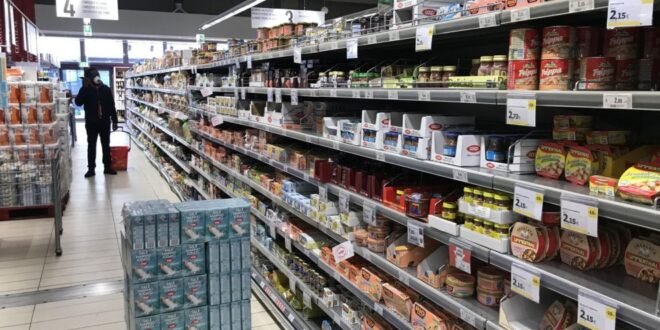
For households, the most painful line in the release may be food. Grocery inflation — the so-called "shopping trolley" of food and household goods — accelerated to 2.5 per cent in October from 1.5 per cent in September, squeezing budgets at the supermarket even before energy bills land.
Underlying inflation is also creeping up, though it remains far below the headline rate. Core inflation, excluding energy and unprocessed food, rose to 2.0 per cent from 1.6 per cent, while inflation excluding energy alone climbed to 2.5 per cent from 2.0 per cent. That pattern suggests the shock is still concentrated in imported energy rather than spreading broadly through the economy — but the direction is uncomfortable.
Pressure on the Government and the ECB
The figures land in the middle of Italy's budget season and a wave of union anger over falling real wages, which remain below their early-2021 levels. A three-year-high inflation rate strengthens the hand of unions demanding contract renewals and pension indexation, and complicates the government's claim that its budget protects purchasing power.
For the European Central Bank, Italy's jump is part of a wider European picture of supply-driven price pressure. Italian markets reacted nervously to the revised figure, with Milan's stock exchange closing lower on the day of the release. Whether October proves to be a peak or a plateau will depend largely on energy markets — and on how much of the surge feeds into the core measures the ECB watches most closely in the months ahead.
Also visit our other websites: GulfCareers — Jobs in Dubai, UAE & Gulf | IndeedOne — Jobs and Information