EuroDaily News and Guidance, Every Day
Related Articles



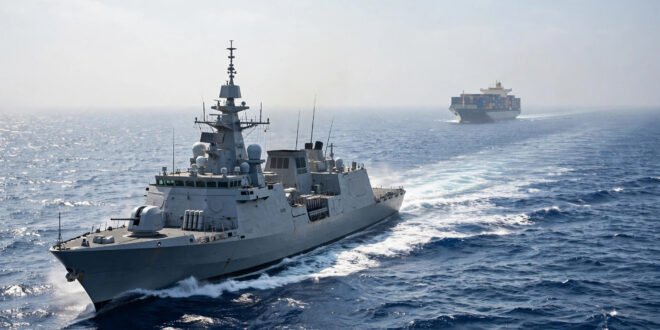
Italy is losing patience with its European partners over security in the Red Sea, and the question of Italy Red Sea warships — how many Rome deploys, and under whose flag — has become a test of the EU's credibility as a maritime power. Defence Minister Guido Crosetto has accused fellow member states of failing to strengthen the bloc's Aspides naval mission, despite months of appeals from Rome and a direct call from the EU's foreign policy chief for more ships.
Crosetto: "I Have Yet to See Anything Concrete"
Crosetto first urged the European Union in September to bolster Operation Aspides, the defensive naval mission launched in February 2024 to protect commercial shipping from attacks by Yemen's Houthi movement. Following his appeal, EU foreign policy chief Kaja Kallas wrote to all 27 member states urging them to contribute more naval assets, warning that more than ten warships would be needed for the mission to operate effectively.
The response, in Rome's telling, has been silence. "I have yet to see anything concrete," Crosetto told Reuters on 10 November, adding that talks among EU states on boosting contributions have so far been inconclusive, partly because some members have limited naval resources to deploy. The European Union has extended Aspides until February 2027 and adjusted elements of its mandate, but the hulls in the water have not matched the ambition on paper.
The minister has also complained about burden-sharing. About one third of European operations depend on Italy's contribution, he argues, while other, larger countries contribute much less — a grievance that extends well beyond the Red Sea to the EU's wider military commitments.
Why the Italy Red Sea Warships Question Matters for Trade
For Italy, the stakes are economic as much as military. According to Assarmatori, one of the country's main shipowners' associations, around 40 per cent of Italy's trade with the rest of the world passes through the Suez Canal, at the northern end of the Red Sea. Disruption in the Bab el-Mandeb strait, at the sea's southern entrance, therefore feeds directly into Italian shipping costs, supply chains and inflation.
That exposure explains why Rome has already signalled a willingness to act alone. Earlier this autumn, Crosetto announced that Italy was prepared to escort its own merchant ships through the Bab el-Mandeb without waiting for Aspides to decide, saying the Italian Navy was capable of guaranteeing passage using intelligence gathered by its services. The frigate Carlo Bergamini has been stationed at Djibouti, and defence sources have spoken of at least a dozen Italian merchant ships waiting to cross the strait under escort. Crosetto stressed at the time that any deployment would be assessed together with the government and parliament, and that the Djibouti area itself is not affected by Houthi actions.
What Happens Next
The dispute now moves to the EU's diplomatic calendar, where foreign ministers will face renewed Italian pressure for concrete pledges of ships and crews. Rome's argument is that a mission designed to be defensive — escorting vessels and responding to attacks, rather than striking targets ashore — should be the easiest kind of operation for member states to support.
Whether partners step forward will say much about the EU's ambitions to act as a serious geopolitical power. If they do not, Italy has made clear it is ready to protect its own shipping under its own flag — and the debate over Italy Red Sea warships will have exposed, once again, the gap between Europe's strategic language and the resources its governments are prepared to commit.
Also visit our other websites: GulfCareers — Jobs in Dubai, UAE & Gulf | IndeedOne — Jobs and Information