EuroDaily News and Guidance, Every Day

Related Articles


Italy schools hoax bomb threats forced evacuations across the country on Wednesday, after threatening emails were sent to about 6,000 schools, according to Italian news agency ANSA, citing the Education Ministry. Prime Minister Giorgia Meloni said there was no concrete danger, and no explosives were found in any school, but the scale of the disruption, thousands of schools, tens of thousands of pupils sent home, and a government meeting with security and intelligence chiefs, made it one of the most alarming days of the year for Italian families.
The threats were reported on 11 and 12 November 2026, and they were not confined to Italy: similar threatening emails were sent to hundreds of schools in Britain and Ireland, and the Italian government linked the episode to a wider wave of hoax alerts that has disrupted flights and public services across Europe in recent weeks. Investigators are examining possible links to a pro-Russian group, according to ANSA, although they have cautioned that this could be deliberate misdirection, and no firm attribution has been made.
Italy Schools Hoax Bomb Threats: What Happened on Wednesday
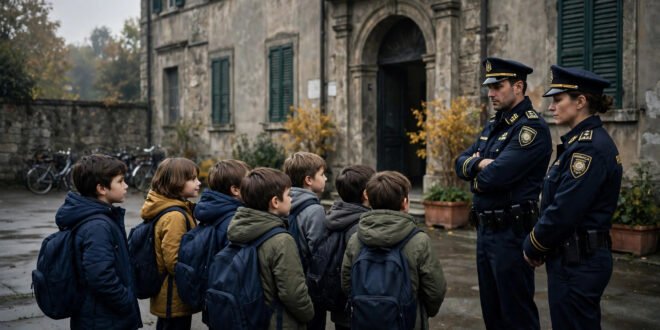
The threatening email reached schools shortly before 10am on Wednesday 11 November, according to the Brussels Signal, which reported that the message went to about 6,000 of Italy’s roughly 7,600 state schools. Not all of them were evacuated, but many were, and photographs from the day showed schoolchildren gathering outside their schools in Rome, Milan and other cities while police carried out checks. A police vehicle was photographed outside a school in Milan, the Istituto Comprensivo Statale Antonio Stoppani, after it was evacuated over the alert, and children were photographed near Trajan’s Forum in Rome after evacuating the Ennio Quirino Visconti school.
The email was purportedly signed by a person identified as “Mikhail Andropov, leader of the Vilayat of Misoginistan”, according to Italian media reports, and it claimed that a remote-controlled device had been hidden in every building, threatened knife attacks on survivors, and said a bomb had been placed in the Prime Minister’s car. The text was reportedly identical to one sent to 271 Italian schools on 2 November, when the sender claimed to speak for Iran’s Islamic Revolutionary Guard Corps. ANSA reported that the latest message had been sent from a compromised account at a university in Taiwan.
Meloni: No Concrete Danger
Prime Minister Meloni moved quickly to reassure the public. In a Facebook post on Wednesday, she said: “At present, based on the checks carried out, no element has emerged that would suggest there is a concrete danger.” She convened a government meeting with security and intelligence chiefs on Wednesday to review the incidents, and she confirmed in a video message that evening that nothing had been found in any school.
The government’s message was that the threats were a hoax designed to generate alarm, and that the checks carried out had found no evidence of an imminent threat. Meloni said the reports appeared to be linked to a strategy aimed at generating alarm and concern, which was the subject of all the necessary in-depth investigations. She also invited opposition leaders to Palazzo Chigi, the prime minister’s official residence, on the morning of Thursday 12 November, to brief them on the situation.
On Thursday, the government issued new instructions to schools: they were told not to carry out an immediate evacuation after receiving a bomb threat email unless there were specific and well-founded grounds to believe the danger was real. Under the new instructions, the decision on evacuation must be made by the local prefect if there are specific reasons for concern. Sources in Meloni’s office noted that schools that evacuated students on Thursday did so before receiving the government circular containing the new instructions.
A Wider Pattern Across Europe
The Italian school threats did not happen in isolation. Similar hoax emails were sent to hundreds of schools in Britain and Ireland, and Meloni linked the school emails to hoax threats that hit at least 27 flights across Europe on 5 November, and to cyberattacks on supermarket refrigeration systems in several European countries, including Italy. Italian Foreign Minister Antonio Tajani said on Saturday that cybercriminals were targeting him and circulating his personal information online because of Italy’s support for Ukraine.
Investigators are examining possible links between the school threats and a wider campaign of disruption, and ANSA reported that early leads pointed towards Moscow, although investigators have cautioned that this could be deliberate misdirection. The email’s purported author, the references to a group opposed to women, and the earlier message claiming to speak for Iran’s Revolutionary Guard Corps, all suggest a sender who is trying to confuse attribution rather than to claim responsibility clearly. Prosecutors in Genoa have opened a case for causing false alarm, disrupting a public service and making serious threats, possibly aggravated by terrorist intent.
What Parents and Schools Were Told
For parents, the day was frightening regardless of the eventual outcome. Thousands of children were sent home or gathered outside their schools while police checked the buildings, and the news that the threats had reached 6,000 schools, more than three quarters of the country’s state schools, made it hard to dismiss the episode as a minor prank. The government’s reassurance, that no explosives were found and that there was no concrete danger, came after the evacuations had already happened, and it could not undo the disruption or the anxiety.
The new instructions issued on Thursday are designed to prevent a repeat of the mass evacuations if similar threats arrive again. By requiring a decision from the local prefect, and by telling schools not to evacuate immediately without specific grounds for concern, the government is trying to balance two risks: the risk of ignoring a real threat, and the risk of allowing a hoax to shut down the school system. It is a difficult balance, and it will be tested if the threats continue. Other reports put the number of schools affected at approximately 6,300, which underlines the scale of the operation required to check them all.
Why the Threats Matter Beyond Italy
The episode matters beyond Italy because it shows how cheap and how disruptive a hoax campaign can be. A single email, sent from a compromised account, forced evacuations at thousands of schools, required police checks across the country, and dominated the news for two days. The cost to the sender was minimal; the cost to the state, in police time, lost school hours and public anxiety, was substantial. That asymmetry is what makes hoax campaigns attractive to whoever is behind them, and it is why governments across Europe are treating the recent wave of alerts, against schools, flights and supermarkets, as a single problem rather than a series of isolated incidents.
For Italy, the threats also come at a sensitive political moment. The government has been a strong supporter of Ukraine, and Tajani’s claim that he is being targeted by cybercriminals because of that support connects the school threats to the wider confrontation between Russia and Europe. Whether that connection is real or whether it is misdirection, as investigators have cautioned, is not yet known, and the investigation is continuing. What is known is that no bombs were found, no one was hurt, and the schools reopened. The question now is whether the threats will stop, or whether they are the start of a longer campaign.
Sources: Malay Mail, Vanguard, Brussels Signal.
Also visit our other websites: GulfCareers — Jobs in Dubai, UAE & Gulf | IndeedOne — Jobs and Information