EuroDaily News and Guidance, Every Day

Related Articles



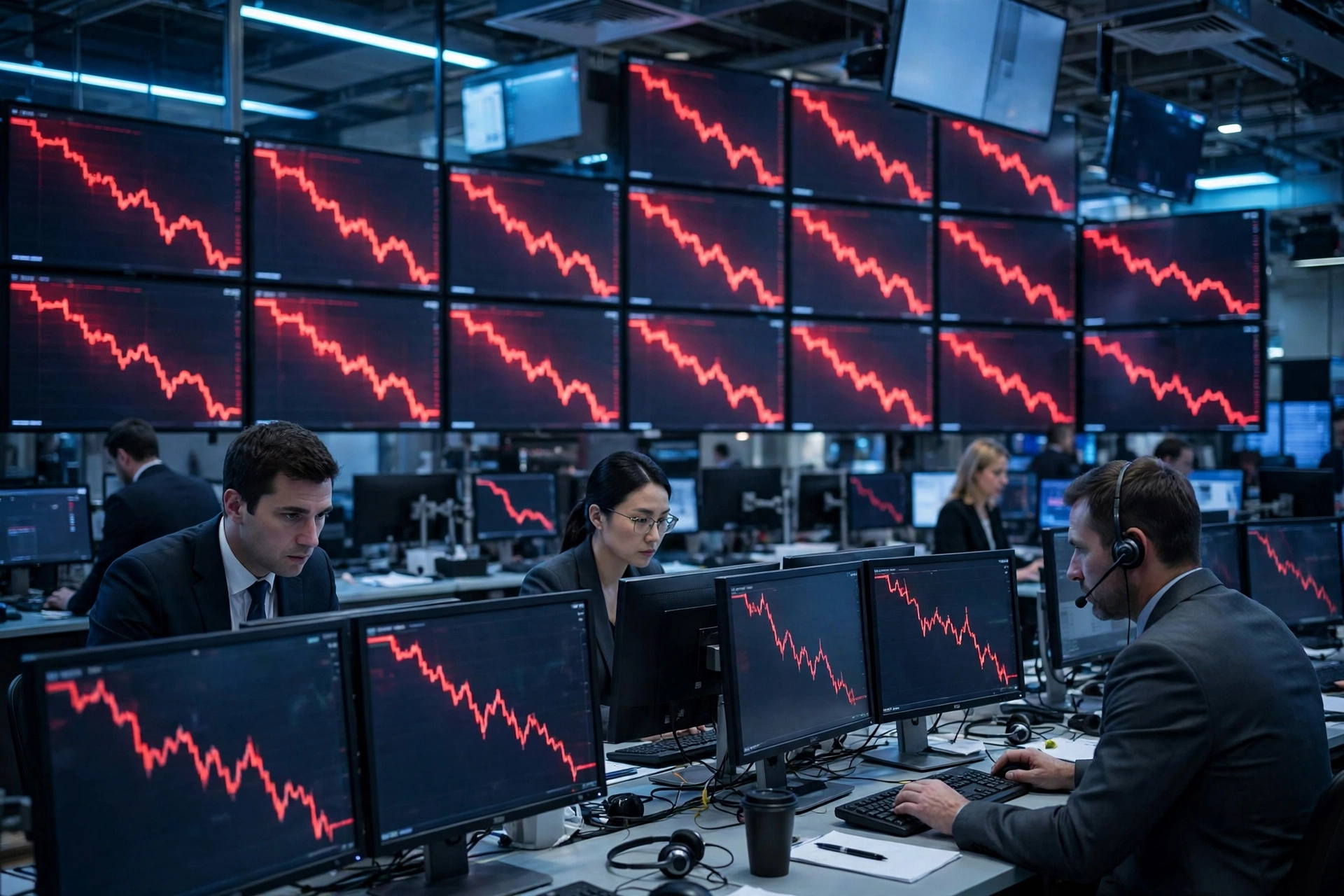
The Nasdaq Composite fell 5.5 percent on Thursday, November 5, 2026, its worst trading day since the tariff selloff of April 2025, as investors sold technology and semiconductor shares after the Democratic Party's sweep of the midterm elections. The index closed at 24,315.00, more than 10 percent below its record close from October — a Nasdaq correction by the usual definition. The S&P 500 fell about 4.3 percent and the Dow Jones Industrial Average dropped more than 1,800 points, or 3.4 percent.
The scale of the losses
The damage was concentrated in the companies that supply the artificial intelligence boom. The Philadelphia Semiconductor Index fell about 12 percent, its second-largest one-day fall on record, according to Reuters. Nvidia, the company most closely associated with the AI boom, fell 9.2 percent. Memory maker SanDisk fell 22 percent, Advanced Micro Devices and Micron each lost roughly 17 percent, and hard-drive maker Western Digital fell 17 percent. Tesla lost nearly 11 percent.
Data-center operators were hit hard as well. Applied Digital, IREN and Nebius, which operate data centers, each fell more than 14 percent, according to Fox Business. The Nasdaq-100, the index of the largest non-financial companies on the Nasdaq, fell 6.4 percent, its steepest one-day drop since March 2020. Estimates of the market value wiped off the Nasdaq ranged from about $2 trillion to $2.5 trillion, while the Financial Times put the total value lost across New York stocks at $3.2 trillion.
The buyers of AI hardware held up better. Meta, a major spender on AI infrastructure, dropped about 4 percent, and Amazon and Alphabet also declined. A few companies with strong earnings rose on the day, including AppLovin, up 31 percent, and Krispy Kreme, up about 31 percent.
Why did the stock market fall on November 5?
The trigger was not a single company's results or a change in interest rates. It was a reassessment of the political risk attached to the physical buildout of artificial intelligence: the data centers, chips, power supplies and cooling systems the technology depends on.
Democrats won both chambers of Congress in Tuesday's midterms, and traders began to worry that new rules could slow down the building of power-hungry data centers. Local opposition has also grown: 40 of 41 data-center ballot measures in 10 states passed, according to the Seoul Economic Daily, and voters have grown wary of AI and higher power bills. Analysts now see the AI infrastructure buildout becoming slower and more expensive, which changes growth forecasts for every company in the chain, from chipmakers to power suppliers.
Spending concerns added to the pressure. Alphabet reported negative free cash flow of about $9.1 billion for the third quarter on capital spending of $51.4 billion, its second straight negative quarter. As Ted Parkhill of Incline Investment Management put it, the market was moving "from the promise of AI to the price of AI."
A repricing, not a verdict
The selloff is best understood as a repricing of companies tied to the AI buildout, not a judgment that artificial intelligence has no long-term value. The Nasdaq-100 had already entered a correction after falling more than 10 percent from its record high, and Thursday's losses deepened that retreat.
Some Wall Street strategists viewed the post-election market rout as a buying opportunity, arguing that the selloff was being driven by short-term political uncertainty rather than a fundamental problem with AI spending. Whether that proves right depends on how quickly policy changes and capital spending plans take shape.
What to watch next
The first test was the October jobs report, released on Friday, November 6, which came in far stronger than expected, with 165,000 new jobs added. That blunted some of the day's gloom, and showed that the labor market had held up better than many expected. Next comes the October consumer price index on November 10, which will show whether inflation remains hot.
Related: Wall Street's $1.5 Trillion Margin Debt Bubble Risk
Sources
- https://khabarwire.com/blog/nasdaq-ai-selloff-2026-11-06/
- https://datafloq.com/nasdaq-falls-5-5-as-investors-price-in-a-slower-ai-buildout/
- https://theevergreenedit.money/investing/nasdaq-correction-dow-falls-1833-points-ai-chip-stocks-plunge/
Related: Nvidia Stock Crash: 22% Drop, Cramer Calls It Cheapest in a Decade
Also visit our other websites: GulfCareers — Jobs in Dubai, UAE & Gulf | IndeedOne — Jobs and Information