EuroDaily News and Guidance, Every Day

Related Articles


Switzerland's economy grew by 0.2% in the third quarter of 2026, slowing sharply from the strong performance of the previous three months. The Switzerland GDP growth third quarter 2026 figure, published by the State Secretariat for Economic Affairs, known as SECO, on Monday 16 November, showed an economy still expanding, but only just, after growth of 1.5% in the second quarter.
The first estimate, adjusted for seasonal swings and the impact of sporting events, was driven by the industrial sector, while the services sector stagnated overall. Economists polled by the AWP news agency had expected the economy to change by between minus 0.3% and plus 0.4%, so the result landed in the middle of the range, but it confirmed that the burst of growth in the spring has faded.
This article explains what the figures show, why growth slowed, how Switzerland compares with its neighbours, and what the numbers mean for the rest of 2026.
What the SECO Figures Show
According to SECO's first estimate, Switzerland's real gross domestic product grew by 0.2% in the third quarter compared with the previous quarter. That is the weakest expansion since the third quarter of 2025, according to preliminary data reported by Trading Economics, and a sharp slowdown from the second quarter's 1.5%, which was the fastest quarterly growth in almost five years.
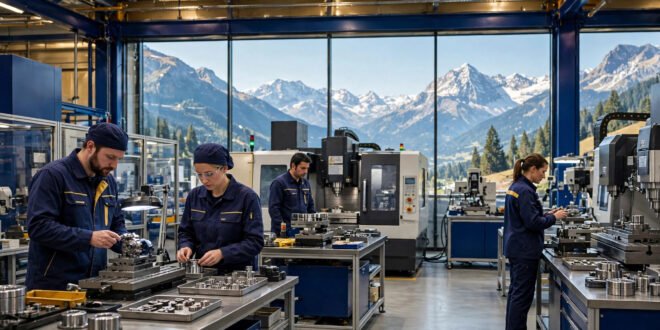
The breakdown tells the story. The industrial sector grew once again, continuing a run of strength that has carried the Swiss economy through much of 2026. The services sector, by contrast, stagnated overall, offering no additional momentum. When services, which account for the largest share of the Swiss economy, stand still, overall growth depends entirely on industry, and that leaves the headline figure fragile.
SECO's economists expect gross domestic product to grow by 1.2% for 2026 as a whole, according to Le Temps. That forecast suggests the economy will keep growing, but at a modest pace, and that the strong second quarter was the exception rather than the new normal.
It is worth remembering that this is a flash estimate. A fuller set of figures, including the expenditure breakdown, is due on 30 November, and the numbers can be revised. The second quarter's 1.5% was itself confirmed after revision, matching the preliminary estimate released in August, but revisions to quarterly growth are common, and the third-quarter figure should be read as an early signal rather than a final verdict.
Why Growth Slowed After a Strong Second Quarter
The second quarter's 1.5% growth was the fastest since the third quarter of 2021, and it set a high bar. Some of that strength reflected factors that were unlikely to repeat, including a surge in activity ahead of changes in the international trading environment. When that surge faded, the underlying pace of the economy reasserted itself.
Trade policy remains the largest source of uncertainty. About a year ago, a preliminary, non-binding framework lowered United States tariffs on Swiss goods from 39% to 15%, according to Trading Economics, but the absence of a formal bilateral agreement continues to weigh on the outlook. Swiss exporters, from pharmaceuticals to precision engineering, sell heavily into the United States, and a 15% tariff is still a significant cost. Until a formal deal is agreed, businesses face uncertainty about the terms on which they will trade.
The Swiss National Bank, in its late-September assessment, projected moderate growth in the coming quarters, and said its monetary policy was having a supportive effect on the economy. With the policy rate at zero, borrowing costs are low by international standards, which should help investment and consumption. But monetary policy cannot offset a weaker external environment on its own, and the third-quarter figures suggest the support has not been enough to keep growth at the second quarter's pace.
Domestic demand also looks subdued. Services stagnating overall points to cautious consumers and businesses, and Swiss consumer spending, while rising 1.6% year on year in October according to PostFinance data, has not been strong enough to drive the economy forward on its own.
How Switzerland Compares With the Euro Area
Switzerland's 0.2% looks modest next to the euro area, where seasonally adjusted gross domestic product increased by 0.4% in the third quarter compared with the previous quarter, according to a flash estimate published by Eurostat, the statistical office of the European Union. The wider European Union grew by 0.5% over the same period.
The comparison should be read with care. Quarterly growth rates move around, and a single quarter does not establish a trend. But the gap underlines that Switzerland, with its heavy reliance on exports and its exposure to United States trade policy, faces headwinds that the euro area, as a larger and more domestically driven bloc, feels less acutely.
There is also a longer-term point. Switzerland's economy has grown more slowly than the euro area at several points in 2026, and SECO's forecast of 1.2% for the year as a whole is below the pace the country achieved in stronger years. For a country used to steady, if unspectacular, growth, that is a reminder that the external environment has become harder.
For readers tracking price pressures alongside growth, our report on the October 2026 CPI report sets out how inflation has moved in the United States, the world's largest economy and a key market for Swiss exporters.
What to Watch Next
The next data point is the full third-quarter release on 30 November, which will show how households, businesses, government and trade each contributed to growth. That breakdown will help economists judge whether the slowdown was mainly about exports, or whether domestic demand also weakened.
After that, attention turns to the Swiss National Bank's final monetary policy assessment of the year on 10 December. The bank held its policy rate at zero in September, and the October inflation reading of 1.5% has raised questions about whether it will move sooner than expected. Growth of 0.2% argues against a rapid tightening, but the bank's mandate is price stability, not growth, and it will weigh both sides.
Trade will remain the wild card. Any progress towards a formal agreement with the United States would remove a significant source of uncertainty for Swiss exporters, while any deterioration would do the opposite. The preliminary framework that cut tariffs to 15% has held for a year, but businesses want certainty, and they will be watching the diplomacy closely.
For now, the message of the third-quarter figures is straightforward: Switzerland's economy is still growing, but only slowly, and the momentum of the spring has gone. Whether the final quarter of 2026 brings a recovery or a further slowdown will depend on industry, on services, and on a trading environment that Bern does not control.
Switzerland GDP Growth Third Quarter 2026 in Context
Put in context, the 0.2% figure is neither a crisis nor a success. Switzerland has avoided recession, and its economy continues to expand at a time when several European countries are struggling. The industrial sector's resilience is a strength, and the labour market has held up better than in many comparable economies.
But the slowdown from 1.5% to 0.2% in a single quarter is a sharp change, and it shows how dependent Swiss growth has become on a small number of drivers. When industry is the only engine, and services stand still, the economy is vulnerable to any shock in export markets.
SECO's forecast of 1.2% growth for 2026 as a whole suggests the year will end respectably, if not impressively. The question for 2027 is whether services can pick up, whether industry can sustain its performance, and whether the trade outlook improves. The answers will shape not only the growth figures but also the decisions of the Swiss National Bank, the federal budget, and the businesses that employ millions of people in Switzerland.
Sources: Le Temps, Reuters via TradingView, Trading Economics.
Also visit our other websites: GulfCareers — Jobs in Dubai, UAE & Gulf | IndeedOne — Jobs and Information