EuroDaily News and Guidance, Every Day

Related Articles



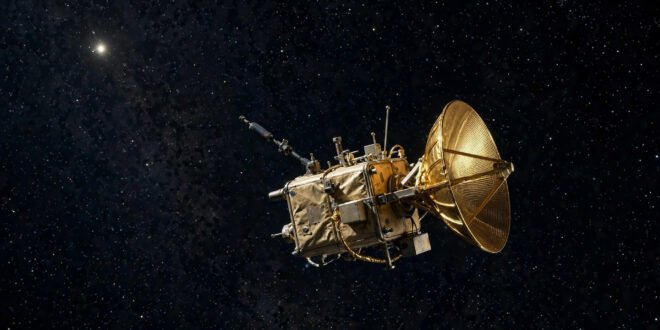
NASA’s Voyager 1 spacecraft will become the first human-made object to sit one full light-day from Earth on Wednesday, November 18, 2026. The Voyager 1 one light-day milestone arrives at 5:16:07 a.m. EST, when the probe stands 16.094 billion miles (25.902 billion kilometres) from our planet.
A light-day is the distance light travels in 24 hours. From Wednesday, a radio command sent from Earth will take a full day to reach Voyager 1, and the answer will take another full day to come back — a 48-hour round trip for every instruction.
The spacecraft itself will notice no change. Nothing aboard will switch on or off, and its surroundings will not change. The milestone describes a communication delay, not a new capability.
Voyager 1 One Light-Day: The Moment
According to mission ephemerides from NASA’s Jet Propulsion Laboratory (JPL), Voyager 1 will cross the 24-hour light-travel threshold at 10:16:07 UTC on Wednesday, November 18, when it stands approximately 25.902 billion kilometres away — 173.14 astronomical units from Earth, more than 5.7 times Neptune’s orbital radius.
It has taken the probe 49 years, two months and 11 days to get there. It left Cape Canaveral on September 5, 1977, riding a Titan-Centaur rocket, and is now coasting at close to 38,000 miles per hour through interstellar space.
What a Light-Day Means
Light is the speed limit, and radio is light. Every message to Voyager 1 travels at 186,282 miles a second and still needs a full day to arrive after November 18.
That changes how the spacecraft is run. Voyager 1’s automatic fault protection will now face any problem two days before Earth can answer it, so the onboard systems — not mission control — are the first responders. As JPL project manager Suzanne Dodd put it in an October 29 update, after saying hello, you “go home and you wait two days” for a reply.
A 49-Year Journey
Voyager 1 flew past Jupiter and Saturn in the late 1970s and early 1980s, using gravity assists at both planets to gain the speed that carried it out of the solar system. It crossed into interstellar space in 2012, and it is now heading in the general direction of a faint star called Gliese 445, roughly 17 light-years away. It should come no closer than about 1.7 light-years to that star, some 40,000 years from now.
Voyager 2, its twin, takes a different path and will not reach one light-day until November 2035, according to NASA. Both spacecraft are expected to remain in range of the Deep Space Network until the 2030s.
The October Warning
The probe gave a preview of life beyond one light-day in October. NASA’s Deep Space Network missed two scheduled contacts with Voyager 1, 24 hours apart, on October 18 and October 19, and the signal returned on October 20.
Engineers found that one group of thrusters had gone offline and that backup thrusters had activated automatically — exactly the response the fault protection is programmed to make. JPL says the cause is under investigation.
How to Wave at Voyager
To mark the milestone, NASA has organised a global public event called “Shine Bright for Voyager’s Light-Day”. After sunset on Tuesday, November 17, in their own time zone, people worldwide are invited to shine a flashlight, glow stick or phone toward the sky and flash out “V-G-R” — Voyager’s call sign — in Morse code.
NASA is clear that the gesture is symbolic: only an incredibly tiny fraction of the photons from Earth would ever reach the spacecraft. On Thursday, November 19, at noon Eastern, JPL will host a public discussion in its von Kármán Auditorium.
For more on NASA’s exploration plans, see our report on NASA’s $10 billion lunar delivery contract.
Sources: TechTimes, IFLScience, CRV Science.
Also visit our other websites: GulfCareers — Jobs in Dubai, UAE & Gulf | IndeedOne — Jobs and Information