EuroDaily News and Guidance, Every Day
Related Articles



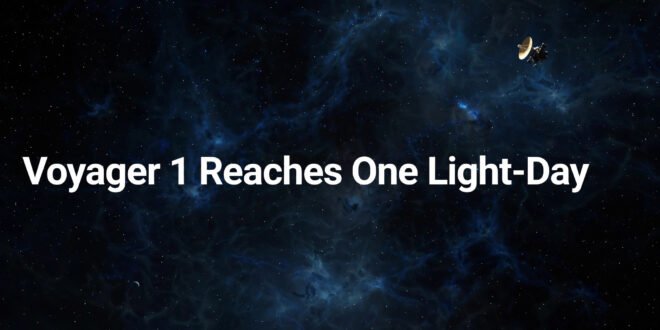
Voyager 1 reaches one light-day from Earth on Wednesday, November 18, 2026, at 5:16:07 a.m. EST (10:16:07 UTC), becoming the first human-made object ever to reach that distance, NASA said. The spacecraft, launched more than 49 years ago, is now about 16.1 billion miles (25.9 billion kilometres) from home — so far away that a radio signal sent from Earth takes a full 24 hours to reach it, and any reply takes another 24 hours to come back. For the engineers still flying a probe built in the 1970s, a simple question and answer now takes two whole days.
The milestone is a measure of distance, not speed, but it captures just how far humanity's farthest traveller has gone. Voyager 1 has been the most distant human-made object since 1998, when it passed Pioneer 10. Now it has crossed a line no spacecraft has crossed before: a distance measured by how far light itself travels in an entire day. NASA described the moment as another historic first in a mission that has already collected a long list of them, and the agency marked the occasion by inviting the public to take part in a worldwide light-flashing event the night before.
What one light-day actually means
A light-day is the distance light travels in a vacuum in 24 hours, and NASA puts that distance at 25.89 billion kilometres, or 173.14 astronomical units — one astronomical unit being the distance from the Earth to the Sun. Light moves at about 186,000 miles per second, according to Nextgov, yet even at that speed it needs a whole day to cover the gap between Earth and Voyager 1. Put another way, the Moon is only 1.3 light-seconds from Earth, the Sun is 8.3 light-minutes away, and Neptune, the most distant planet, is 4.2 light-hours away, Voyager project scientist Linda Spilker told Sky and Telescope. Voyager 1 has now gone far beyond all of them, into a realm measured in whole days of light travel.
The crossing itself changes nothing for the spacecraft. As Nextgov reported, Voyager 1 will not notice anything special about passing the one-light-day line: there is no new boundary in space to cross, no change in the thin interstellar wind around it. The significance is human, not physical. It is a way of measuring, in terms anyone can grasp, just how far a machine built by people has travelled from home. NASA's own explainer on the milestone makes the same point, describing one light-day as a distance measured from Earth, and noting that the exact moment the signal time reaches 24 hours can shift slightly as both the Earth and the spacecraft move.
For the team at NASA's Jet Propulsion Laboratory (JPL) in California, the practical meaning is immediate. Every command they send now takes a day to arrive, and confirming whether it worked takes another day. As Nextgov put it, even asking Voyager 1 whether a command or repair worked can now require about two days for the question and answer to make the round trip. That 48-hour communications loop is the new reality of operating the most distant spacecraft ever flown.
The exact moment: 5:16:07 a.m. EST
NASA fixed the milestone to a precise second: 5:16:07 a.m. EST on Wednesday, November 18, 2026, which is 10:16:07 UTC and 2:16:07 a.m. PST, according to IFLScience, which confirmed the timing directly with the Voyager mission team. USA Today, reporting on the milestone, gave the same time — 5:16:07 a.m. EST — and the same distance of about 16 billion miles. ScienceAlert also reported the moment as 10:16 UTC on November 18, at a distance of 25.9 billion kilometres from Earth.
The precision matters because the distance is not fixed. Voyager 1 is hurtling away from the Sun at about 38,000 miles per hour (61,100 kilometres per hour), ScienceAlert reported, while NASA gives the figure as more than 37,800 mph. At that speed the spacecraft covers roughly 900,000 miles every day, so the one-light-day mark is a moving target. IFLScience noted that NASA had warned the exact moment when signals take 24 hours might differ slightly from the forecast, because of the motions of both the spacecraft and the Earth — but the predicted time held.
A 49-year journey that began in 1977
Voyager 1 launched on September 5, 1977, as part of a twin-spacecraft mission that transformed scientists' understanding of the outer solar system, Nextgov reported. Its sister craft, Voyager 2, had launched a few weeks earlier, on a different trajectory. Both were built to take advantage of a rare alignment of the outer planets, and both were originally expected to operate for only a few years. Nearly half a century later, both are still sending data from interstellar space.
Voyager 1 flew past Jupiter and Saturn, and its encounter with Saturn's moon Titan shaped the rest of its path, sending it north of the plane of the planets, Spilker told Sky and Telescope. Voyager 2 took a different road, heading south after visiting Jupiter, Saturn, Uranus and Neptune — the only spacecraft ever to visit those last two planets. The two probes are the only human-made objects ever to operate outside the heliosphere, the protective bubble of particles and magnetic fields generated by the Sun, according to NASA, as reported by ScienceAlert.
Voyager 1 became the first human-made object to enter interstellar space, crossing the boundary of the heliosphere in 2012, and it has been travelling through the space between the stars ever since. Its antenna remains pointed at Earth at all times, Spilker said, so that the faint signals it sends can still be picked up by NASA's Deep Space Network. The spacecraft is car-sized, and it is running on hardware launched in 1977 — technology older than most of the engineers now operating it. Both spacecraft also carry the Golden Record, a gold-plated copper disc with sounds and images of Earth, intended as a message to any civilisation that might one day find them.
How NASA still talks to a probe a day away
Communicating with Voyager 1 is an exercise in patience. Commands travel outward at the speed of light, which means each one takes 24 hours to arrive, and the spacecraft's replies take just as long to return. The data comes back slowly, too: commands go to the probe at just 16 bits per second, and the science data returns at a similarly modest rate, according to reporting on the mission. Every instruction must be right the first time, because a mistake takes two days to discover and another two days to correct.
The spacecraft runs on dwindling power. Its electricity comes from radioisotope thermoelectric generators, which convert heat from decaying plutonium into power, and their output falls a little every year. NASA has been switching off heaters and instruments one by one to stretch the remaining power, and the agency hopes Voyager 1 will keep communicating with Earth into the early 2030s, ScienceAlert reported, before its power supply finally drops below the minimum needed to run anything at all.
The engineering team has pulled off remarkable recoveries over the years, including working around failed thrusters and a clogged fuel line, but the one-light-day milestone brings a new constraint: the round trip for any fix is now two full days. As Nextgov noted, NASA is still operating hardware launched in 1977, and the 48-hour loop means the team must plan every move further ahead than ever before. Even so, the spacecraft keeps sending back data about interstellar space that no other instrument can provide, because no other instrument has ever been there.
The world shone a light back: Shine Bright for Voyager
To mark the milestone, NASA invited people around the world to go outside after sunset on Tuesday, November 17, and shine a light into the night sky for Voyager 1. The campaign, called "Shine Bright for Voyager's Light-Day", asked participants to point a flashlight, a phone or a glow stick at the sky and flash the letters V-G-R — the probe's designation — in Morse code. USA Today reported that NASA was inviting the public to shine a light from a phone or other light source into the night sky on Tuesday night, and ScienceAlert reported the same call for people to join the celebrations.
The gesture was symbolic: no light shone from Earth can ever catch a spacecraft a light-day away, and the probe has no camera that could see it. But the point was participation, not physics. For one evening, people on the planet the Voyagers left behind could look up and think about a machine, built by their species, that is now a full day of light travel away. It was, in NASA's framing, a shared moment of wonder at a distance that is almost impossible to picture.
On Thursday, November 19, NASA officials will host a moderated discussion at JPL in Southern California about the status of Voyager 1 and 2, USA Today reported. The discussion is expected to cover what the two spacecraft are still measuring, how much longer they can keep going, and what scientists have learned from nearly five decades of data from beyond the Sun's influence. A preview of a Voyager documentary is also due in 2027 on NASA+, the agency's streaming service, giving the mission a new audience as it approaches its 50th anniversary.
What comes next for Voyager 1 and Voyager 2
Voyager 1 will keep travelling outward, growing more distant by roughly 900,000 miles every day, until its power finally runs out in the early 2030s. NASA's hope, reported by ScienceAlert, is that contact can be kept into that decade, squeezing every last measurement from the instruments that remain switched on. When the power finally falls too low, the spacecraft will go silent — still travelling, still carrying the Golden Record, but no longer able to call home.
Voyager 2, heading in a different direction and moving slightly more slowly, will reach one light-day in November 2035, according to NASA. But as Spilker told Sky and Telescope, by that time it will no longer have enough power to send signals back to Earth. Voyager 1, in other words, is likely to be the only spacecraft whose one-light-day crossing humanity ever hears about in real time. Its twin will cross the same line in silence, years after contact is lost — still travelling, and still carrying the Golden Record.
Why this milestone matters
The one-light-day mark matters because it turns an abstract number into something felt. Sixteen billion miles is hard to imagine; a day of light travel is easier. It means that if you could somehow watch Voyager 1 in real time, you would see it as it was yesterday. It means that the fastest thing in the universe needs a full day to bridge the gap between us and something we built. And it means that humanity has now placed an object a full light-day from home — the first time any species on Earth, as far as we know, has done such a thing.
It also matters as a reminder of what long-term science can achieve. The Voyager mission was planned for a few years and has lasted nearly fifty. It has outlived its designers' expectations, survived hardware failures that should have ended it, and kept returning data from a place no other spacecraft has reached. As NASA put it, Voyager 1 will be the first human-made object to reach this distance from Earth, adding another historic first to the mission's long list, ScienceAlert reported.
For the full background on what a light-day is and how NASA planned this moment, read our earlier preview, Voyager 1: one light-day from Earth. For the mission team's own account, see NASA's explainer on what a light-day is, ScienceAlert's report on the milestone, and Nextgov's account of the 48-hour communications loop. Voyager 1 is now a light-day away — and still, incredibly, talking.
Also visit our other websites: GulfCareers — Jobs in Dubai, UAE & Gulf | IndeedOne — Jobs and Information