 EuroDaily News and Guidance, Every Day

Related Articles


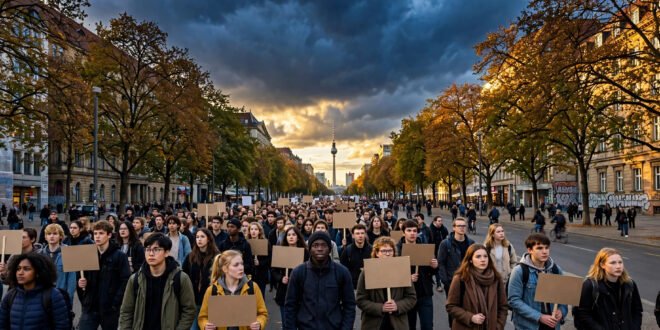
Around 1,200 young people marched through Berlin on Saturday in a protest organised by the “Gen Z regelt” initiative, far more than the 100 participants the organisers had registered, in a demonstration that ended with 20 people provisionally detained and 28 criminal charges filed. The Berlin Gen Z protest was a preview of a much larger mobilisation: the organisers have called a Europe-wide youth strike for 20 November, with 15,000 participants registered for the Berlin event alone.
The march began at about 5pm at Savignyplatz in Charlottenburg and moved along the Kurfürstendamm towards Halensee station, where it ended in the early evening. Police said about 1,200 people were present, and deployed about 700 officers to manage the route. The demonstrators were protesting against run-down schools, the prospect of compulsory military service, cuts to universities and social spending, and the rising cost of living.
The protest was the second outing for the initiative, which first demonstrated nationwide on 31 October, and it comes as youth discontent becomes a visible force in German politics. This report explains what happened on Saturday, what the protesters want, and what is planned for 20 November.
What Happened on Saturday in Berlin
The demonstration was organised by the “Gen Z regelt” initiative, which translates roughly as “Gen Z takes charge”, and was called by various left-wing alliances, including the initiative’s Berlin branch, ORT Berlin and the Communist Youth League, according to reports. The march began at 5.30pm at Savignyplatz, according to Berlin’s assembly calendar, and was directed against militarisation, cuts in education and conscription.
Police counted around 1,200 people in the streets, roughly twelve times the 100 who had been registered. A police spokeswoman said on Sunday morning that 20 people had been provisionally detained, two fewer than the 22 announced on Saturday evening, after the figures were reviewed. Three officers were injured, according to reports, and police filed 28 criminal charges covering breach of the peace, assault, resisting officers and violations of explosives law.
Officers said pyrotechnics and occasional clashes led to the charges, and the demonstration was largely dispersed near Halensee railway station, where police escorted demonstrators onto trains. Gatherings also took place in a number of other German cities on the same day.
What the Protesters Are Demanding
The demonstrators’ slogans were directed against dilapidated schools, compulsory military service, cuts to university and social funding, and other issues, according to dpa. The initiative’s own call for the protest listed broken schools, conscription, soaring prices, cuts to universities and social spending, surveillance, a shift to the right and patriarchy among its targets.
Education is at the centre of the movement. Protesters point to run-down school buildings, cuts to university funding and reductions in social spending as evidence that young people are paying the price for the government’s priorities. The rising cost of living is a further grievance, with young people facing high rents and living costs in cities such as Berlin.
Military service is the most politically charged issue. Germany is debating the reintroduction of some form of compulsory military service, and the prospect of conscription has become a rallying point for young people who oppose it. Pro-Palestinian activists also joined Saturday’s gathering, bringing international political concerns into the wider youth-led demonstration, according to reports.
Why the Turnout Surprised the Authorities
The gap between the 100 registered participants and the roughly 1,200 who turned up is the most striking fact about Saturday’s protest. The organisers had registered the event for 100 people, and the authorities braced for a small march. Instead, about a dozen times as many showed up, which suggests the movement is reaching well beyond its organised core.
The initiative first demonstrated nationwide on 31 October, and Saturday’s march was its second outing. The growth in numbers between the first and second demonstrations, and the spread to other German cities, indicates a movement that is gaining momentum rather than fading after its first appearance.
The mix of political symbols and anti-government chants has complicated policing and public perception, according to reports, and officials in North Rhine-Westphalia and other states have announced readiness units and large police deployments ahead of the Europe-wide youth strike on 20 November to prevent violent groups from seizing the protests.
What Is Planned for 20 November
The organisers’ announcement said “Phase 2 begins”, and the next stage is already on the calendar. On 20 November, they want to bring far more people onto the streets in Berlin, elsewhere in Germany and across Europe, in what they describe as a Europe-wide youth strike. For the Berlin event alone, they have registered 15,000 participants.
Protests are also expected in France, Italy, Spain, Belgium and the United Kingdom, and the initiative has called a nationwide day of protest with demonstrations planned in 39 German cities, according to reports. If the Berlin turnout matches the registration, it would be more than ten times the size of Saturday’s march.
Police preparations are already under way. Officials in several states have announced that they will deploy large numbers of officers, and the authorities are clearly concerned that the scale of the 20 November events could lead to further clashes. The organisers, for their part, have framed the strike as the next step in a growing movement.
What the Protests Mean for German Politics
For Germany’s government, the youth protests are an unwelcome new pressure. Chancellor Friedrich Merz’s coalition is already dealing with a leadership contest inside its junior partner, the SPD, a tight energy situation heading into winter, and job losses in industry. A youth movement that can bring 1,200 people onto the streets with only 100 registered, and that claims 15,000 for its next event, is a political fact the government cannot ignore.
The protests also reflect a generational divide. For many younger Germans, concerns about their financial future, education and compulsory military service have become important political issues, and the movement gives those concerns a visible, organised form. Whether it becomes a lasting political force or a short-lived wave will depend in part on what happens on 20 November.
For now, Saturday’s march is best read as a warning: a small, newly formed initiative has shown it can mobilise well beyond its registered numbers, and its next test, the Europe-wide youth strike, is four days away.
For more on how young voters are shaping politics elsewhere, see our report on the 2028 poll on Vance, Rubio, Ossoff and Buttigieg.
Sources: The Berlin Spectator, ABNA24, Particle News.
Also visit our other websites: GulfCareers — Jobs in Dubai, UAE & Gulf | IndeedOne — Jobs and Information
