EuroDaily News and Guidance, Every Day

Related Articles


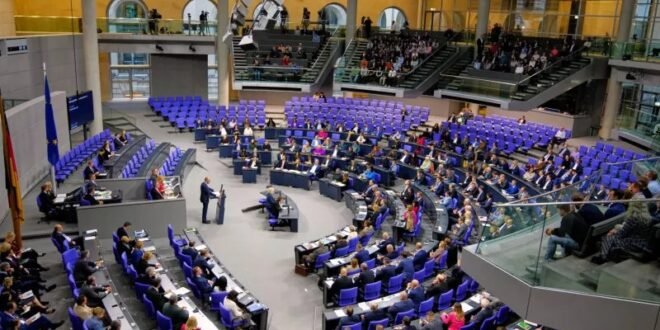
The Germany 2027 budget vote in the Bundestag this week is the biggest domestic test yet for Chancellor Friedrich Merz's coalition, which must pass a spending plan of €560.92 billion while most voters tell pollsters they oppose the record borrowing behind it. The Budget Committee approved the plan on 13 November, clearing the way for the final parliamentary vote scheduled for 24 to 27 November.
According to the figures reported from the committee, the plan relies on roughly €210.4 billion in total new borrowing, including €122.97 billion in the core budget. That scale of debt is the political problem: ZDF's Politbarometer found 59% of respondents opposed to very high federal borrowing, including 54% of supporters of Merz's own CDU/CSU alliance.
A Coalition Governing Against the Polls
The numbers behind the government are uncomfortable. Three national polls published between 10 and 13 November put the far-right Alternative for Germany (AfD) ahead on 27% to 28%, with the CDU/CSU on 20% to 22%. In ZDF's survey, the two governing parties together reached only 35% — short of a majority if an election were held now. Forsa's 10 November poll found just 11% of respondents satisfied with Merz's performance, against 86% dissatisfied.
None of that changes the parliamentary arithmetic this week. The coalition still commands a majority in the Bundestag and can pass its budget. But governing parties that trail in the polls have less room for internal rebellion, and every concession made to hold the coalition together becomes harder to sell to voters who already doubt the plan.
What the Money Is Meant to Buy
The borrowing is not, in the government's telling, consumption for its own sake. Berlin has committed itself to a long programme of infrastructure renewal and higher defence spending, and ministers argue that years of underinvestment left the state with no cheaper option than to borrow heavily now. The budget is the financial expression of that argument: big spending today in exchange for stronger growth and security tomorrow.
Critics answer that the government has been slower to deliver the reforms that would make the borrowing pay. The coalition only recently settled its long dispute over an electricity tax cut, agreeing to extend the reduction to all consumers and add a fuel price cap from January 2027. Business groups continue to complain about high energy costs, weak private investment and industrial job losses, and the European Commission forecasts German growth of only 1.3% this year, easing further in 2027 and 2028.
Why This Week Matters Beyond Berlin
Germany is the eurozone's largest economy and the European Union's biggest net contributor, and its fiscal choices ripple outward. Merz has simultaneously argued in Brussels that the next long-term EU budget is still too large, while asking partners to share more of the cost of supporting Ukraine. A chancellor demanding restraint abroad while borrowing at record levels at home will face pointed questions on both fronts.
The vote itself is unlikely to fail. The real question is what it costs the coalition in authority. If the budget passes on schedule, Merz buys his government a year of financial certainty. If the debate exposes fresh cracks between the CDU/CSU and the SPD, the AfD — watching from the top of the polls — will be the first to benefit.
Also visit our other websites: GulfCareers — Jobs in Dubai, UAE & Gulf | IndeedOne — Jobs and Information