EuroDaily News and Guidance, Every Day
Related Articles



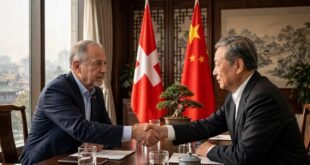
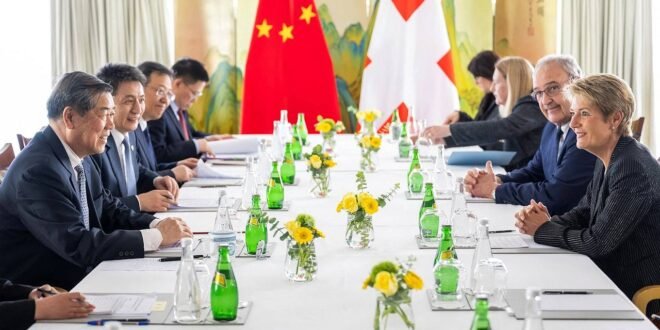
The Cassis Wang Yi talks in Nanjing on Monday brought Switzerland's foreign minister face to face with his Chinese counterpart for the fifth round of the strategic dialogue between the two countries — and produced a pointed request from Beijing: that neutral Switzerland help smooth China's trade differences with the European Union.
A Two-Day Visit, a Full Agenda
Federal Councillor Ignazio Cassis, head of the Federal Department of Foreign Affairs (FDFA) and Vice President of the Federal Council, travelled to Nanjing in Jiangsu province for a visit running 23–24 November at the invitation of Wang Yi, China's foreign minister and a member of the Political Bureau of the Communist Party's Central Committee. China's foreign ministry announced the visit on Sunday through Xinhua.
According to the FDFA, the discussions covered bilateral relations and a series of current international issues, notably the war in Ukraine and the situation on the Korean Peninsula. The Swiss announcement of the trip also listed human rights, mediation, and economic, scientific and cultural cooperation among the dialogue's themes. The strategic dialogue is the highest-level regular consultation between the two foreign ministries; the previous round took place in Bellinzona in October 2025.
Beijing's Asks: the EU, Taiwan and AI
Reporting of the Chinese readout, carried by Reuters on Monday, showed how much Beijing wants from the relationship. Wang told Cassis that China hopes Switzerland will oppose "Taiwan independence" with concrete actions and "play a positive role in the smooth resolution of China-EU economic and trade differences". He also urged the two countries to move beyond what he called the narrative trap of "trade imbalances" and settle differences through dialogue, according to Bloomberg's account of the Chinese foreign ministry statement.
Wang also proposed that the two sides conduct dialogue and cooperation on artificial intelligence at bilateral and multilateral levels — a theme the Chinese statement said both countries agreed to deepen, alongside cooperation in finance and technology.
Why Beijing Courts Bern
The Cassis Wang Yi talks are the latest step in one of China's oldest European relationships. Switzerland was among the first Western countries to recognise the People's Republic of China, in 1950, and in 2014 it became one of the first continental European states to put a free trade agreement with China into force. Switzerland is not a member of the European Union, which is precisely what makes Bern useful to Beijing: a wealthy, stable interlocutor inside Europe's economic orbit but outside Brussels' decision-making.
Neutrality adds a second asset. Switzerland's tradition of good offices — hosting sensitive talks and representing interests where embassies have closed — gives it a mediator's credibility few European capitals can match. When Wang asks Switzerland to play "a positive role" on China-EU trade differences, he is inviting Bern to use that standing in a dispute — over tariffs, market access and industrial competition — where direct channels between Beijing and Brussels have repeatedly stalled.
The Trade Pact Moving in the Background
The talks follow directly on the visit of Federal President Guy Parmelin to President Xi Jinping on 30 October, at which the optimised Swiss-Chinese free trade agreement was signed. According to the Chinese statement reported by Bloomberg, Wang and Cassis agreed to accelerate the domestic approval procedures for the upgraded pact.
For Switzerland, the sequence is deliberate: a small, neutral state with an outsized trading relationship with China keeps every channel open at once — the trade deal at home, the dialogue abroad, and a mediator's role that Beijing is now openly inviting it to extend toward Brussels.
Also visit our other websites: GulfCareers — Jobs in Dubai, UAE & Gulf | IndeedOne — Jobs and Information