 EuroDaily News and Guidance, Every Day

Related Articles


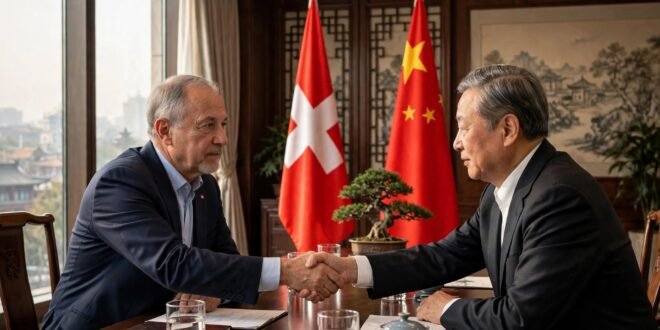
The Switzerland China strategic dialogue reached its fifth round on Monday, as Federal Councillor Ignazio Cassis met Chinese Foreign Minister Wang Yi in Nanjing to mark ten years of the two countries' innovative strategic partnership and to discuss a relationship that Bern regards as one of its most important outside Europe.
Cassis, who heads the Federal Department of Foreign Affairs and serves as Vice President of the Swiss Federal Council, travelled to the capital of Jiangsu province for the talks on 23 November. Wang Yi, who is also a member of the Political Bureau of the Communist Party of China Central Committee, co-chaired the meeting. According to the Chinese readout, Wang said the partnership has been accelerating towards new and higher-quality development under the guidance of the two countries' leaders, staying at the forefront of China-Europe relations.
What the Switzerland China Strategic Dialogue Covered
The Swiss foreign ministry said the discussions covered bilateral relations alongside a number of current international issues, notably the war in Ukraine and the situation on the Korean Peninsula. Switzerland, which hosted the Bürgenstock peace summit on Ukraine in 2024 and traditionally offers its good offices in conflicts, has a standing interest in how Beijing positions itself on the war, given China's close relationship with Russia.
On the bilateral side, both sides agreed to make good use of the dialogue mechanisms in various fields and to deepen mutually beneficial cooperation in finance, science and technology, intellectual property rights, artificial intelligence, telecommunications and education, and to further improve the innovative strategic partnership. The breadth of that list reflects how far the relationship extends beyond trade: Switzerland is home to major Chinese banking and technology interests in Europe, while Swiss pharmaceutical, machinery and watchmaking companies count China among their largest markets.
Ten Years of an Innovative Strategic Partnership
The partnership being celebrated was launched in 2016, when Switzerland became the first country to agree an "innovative strategic partnership" with China. The label built on a longer history of firsts: Switzerland was among the first Western states to recognise the People's Republic in 1950, and in 2013 it became the first continental European country to sign a free trade agreement with Beijing, which entered into force the following year. Both governments have since discussed modernising that agreement to cover more sectors and reflect new priorities such as sustainability and digital trade.
For Bern, the Nanjing meeting fits a deliberate strategy of maintaining direct channels with Beijing even as relations between China and much of the West have cooled. Swiss officials argue that a small, neutral export nation cannot afford to choose camps, and that regular dialogue is precisely what allows Switzerland to raise difficult subjects — from human rights to the war in Ukraine — directly rather than through statements.
The economic weight behind the diplomacy is considerable. China is Switzerland's third-largest trading partner after the European Union and the United States, and its most important market in Asia. Swiss exports range from pharmaceuticals and chemicals to watches, precision instruments and machinery, while the Swiss financial centre has become a European hub for Chinese banks and for offshore renminbi business. That interdependence is exactly why Bern invests in the relationship's political machinery: when disputes arise over market access, technology or regulation, both sides have an established table at which to raise them, rather than relying on public pressure.
Why the Meeting Matters
The fifth round of the Switzerland China strategic dialogue underlines how both capitals see value in the format. For China, Switzerland offers a respected, non-EU partner in the heart of Europe at a moment when Beijing's ties with Brussels are strained. For Switzerland, the talks confirm access at the highest level in Beijing and a chance to advance the interests of its exporters and financial centre. The next test will be whether the warm words in Nanjing translate into concrete progress, including on the long-discussed upgrade of the free trade agreement.
Also visit our other websites: GulfCareers — Jobs in Dubai, UAE & Gulf | IndeedOne — Jobs and Information
