 EuroDaily News and Guidance, Every Day
Related Articles



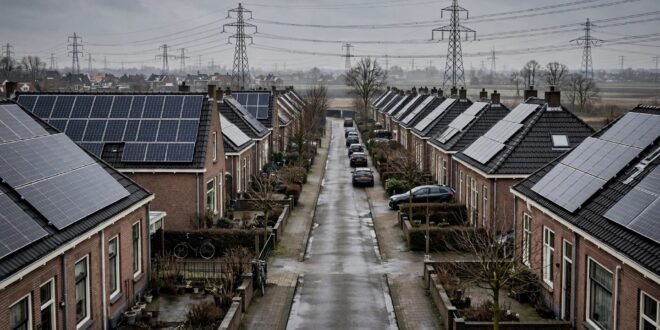
Dutch energy bills 2027 will look different from the first week of January, and for most households they will be higher. The energy regulator ACM expects network tariffs, the cost of transporting electricity and gas to the home, to rise by an average of about 20%, while the long-running net metering scheme that has rewarded owners of solar panels comes to an end.
The changes arrive on top of already substantial bills. On new contracts priced on 23 November 2026, electricity cost on average €0.323 per kilowatt-hour and gas €1.771 per cubic metre, including energy tax and VAT. A two-person household in an average home currently pays about €2,944 a year once fixed charges and the tax rebate are counted.
Dutch Energy Bills 2027: The Network Charge Rise
The biggest single change is the network tariff. ACM expects households to pay on average about €89 more per year for electricity transport and €52 more for gas in 2027, roughly €141 in total. Transport tariffs make up about 30% of an average household's energy bill, so the increase flows directly into monthly advance payments, which suppliers usually adjust in January.
The money is not disappearing into profits. The tariffs are the first set under a new revenue methodology agreed for the 2027–2031 regulatory period, and they fund an enormous programme of grid expansion: new cables, transformer stations and connections for offshore wind, with system operators' investment needs estimated at around €235 billion over 15 years. The Netherlands is electrifying transport, heating and industry faster than its congested grid was built for, and households are being asked to share the cost of catching up. The figures remain tariff proposals until ACM sets the final rates, which are expected late this year.
The End of Net Metering
For the country's large stock of rooftop solar owners, the second change may matter more. From 1 January 2027, the salderingsregeling, or net metering scheme, stops: households will no longer be able to offset the solar power they feed into the grid against the power they use. Instead, every kilowatt-hour fed back will earn a feed-in payment that by law must be at least half the supply price excluding tax and VAT, currently about €0.06 per kilowatt-hour, far below the full retail rate they effectively receive today. The change rewards households that use their own solar power as it is generated, and has revived interest in home batteries, although consumer organisations caution that a battery will still struggle to pay for itself through bill savings alone.
The spread of bills remains wide. Using market-average prices and official usage figures, a one-person household currently pays about €2,257 a year, while a four-person household pays about €4,114, so the network increase will land very differently depending on the size of the home and how much gas it burns. Solar owners face the most complicated calculation: the end of net metering can add several hundred euros a year for a home that feeds back a large share of what it generates, partly offset because the feed-in charges suppliers levy are expected to fall in 2027 contracts. Consumer groups advise solar households to shift consumption into sunny hours, running washing machines, dishwashers and car charging while the panels are producing, since every kilowatt-hour used at home is worth far more than one exported at the feed-in rate.
There is some relief elsewhere on the bill. The government did not raise household energy tax in its 2027 tax plan, and the fixed tax reduction per connection stays at almost the same level, €519.58 excluding VAT, against €519.80 in 2026. An emergency energy fund of €193 million is also planned to support low-income households with high bills through the winter of 2027.
The message for households is to check their advance payment in January rather than be surprised by it, and, if their contract is ending, to compare suppliers carefully: with network costs fixed by the regulator, the remaining differences in Dutch energy bills 2027 will come from supply prices and, for solar owners, the feed-in rate.
Also visit our other websites: GulfCareers — Jobs in Dubai, UAE & Gulf | IndeedOne — Jobs and Information
