EuroDaily News and Guidance, Every Day
Related Articles



Driving in Europe is one of the great travel pleasures, but it is not one system. Cross a border and the way you pay for motorways, the speed limits, the equipment you must carry and even the drink-drive limit can all change. A little preparation before a road trip can save a great deal of money in fines, because most of these rules are enforced automatically and the penalties for ignoring them are steep.
The basics first. Traffic drives on the right everywhere in the European Union except Ireland, and seatbelts are compulsory for everyone. Speed limits follow a familiar pattern, typically 50 km/h in built-up areas, 80 to 100 km/h on rural roads and 120 or 130 km/h on motorways, although Germany's autobahns famously have no general limit on many sections, only a recommended 130 km/h. Drink-drive limits are stricter than many visitors expect: 0.5 grams per litre in most countries, and zero tolerance in Czechia, Slovakia, Hungary and Romania.
Driving in Europe: Vignettes and Tolls
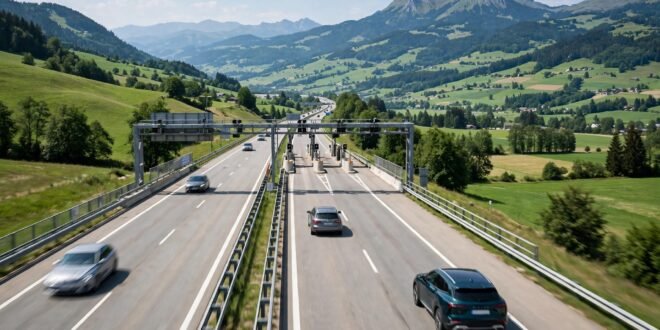
Nine European countries charge for motorways with a vignette, a time-based pass linked to your number plate. Switzerland sells only one product, an annual vignette costing 40 Swiss francs that is valid for 14 months; there is no short-term option, and driving without one brings a fine of 200 francs on top of the vignette you still have to buy. Austria offers a one-day digital vignette for €9.60, a 10-day vignette for €12.80 and an annual pass for €106.80; Austria is issuing its familiar windscreen sticker for the last time in 2026, with the system going fully digital from 1 February 2027. Czechia charges 230 koruna for one day or 300 koruna for 10 days, and registered electric cars are exempt. Slovakia's vignettes start at €8.10 for a day, while Slovenia's annual pass costs €117.50.
France, Italy, Spain and Portugal do it differently, charging per section at toll booths or by automatic plate recognition, so a long crossing can add up quickly. Germany, Belgium and the Netherlands charge cars nothing for motorways. Buy vignettes only from official operators or automobile clubs: unofficial websites add heavy markups, and a vignette bought for the wrong plate or dates is worthless. Note that some Alpine tunnels and passes, such as Austria's Brenner route, charge a separate toll on top of the vignette.
Documents deserve the same attention as the car. Within the EU and EEA, a valid driving licence from any member state is accepted everywhere, and most non-European licences are accepted for short visits, although some countries ask visitors from outside Europe to carry an International Driving Permit alongside their licence; British drivers, since Brexit, can generally use their photocard licence in the EU without one, but should check for specific countries. Carry the vehicle's registration document and proof of insurance, and if the car is rented or borrowed, written permission from the owner can prevent a long conversation at a border. Using a handheld phone while driving is banned across Europe, and penalties for speeding rise steeply in some countries, with fines in parts of Scandinavia linked to income.
Low-Emission Zones, Winter Tyres and Kit
Cities add another layer. France's Crit'Air system requires a coloured sticker showing your vehicle's emissions class to enter low-emission zones in cities such as Paris and Lyon, and the sticker must be ordered in advance. German cities require a green emissions sticker for their environmental zones. Austria requires winter tyres, or carrying chains, from 1 November to 15 April, while Germany imposes a situational rule: winter tyres are mandatory in wintry conditions, whenever they occur.
Finally, pack the kit the law expects: a warning triangle and a high-visibility vest are compulsory in much of Europe, and in France and Spain the vest must be reachable inside the cabin, not buried in the boot. Driving in Europe rewards the driver who checks the rules country by country before setting off; the open road is still there, it just comes with paperwork.
Also visit our other websites: GulfCareers — Jobs in Dubai, UAE & Gulf | IndeedOne — Jobs and Information