 EuroDaily News and Guidance, Every Day
Related Articles
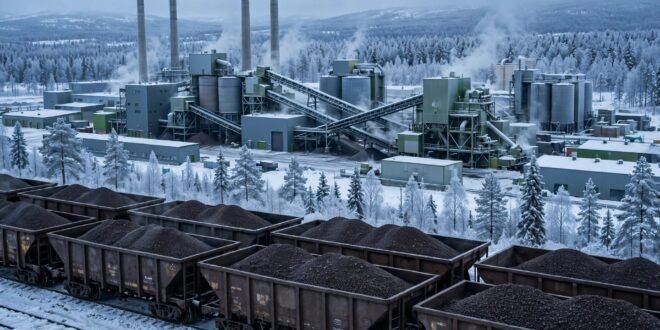
The LKAB Stegra deal signed this week marks a significant step for Sweden's green steel ambitions, as the state-owned mining group and the steelmaker Stegra agreed to expand their cooperation on iron ore pellet supply for the integrated plant now under construction at Boden in northern Sweden.
The two companies announced on 23 November that they had signed a memorandum of understanding taking their partnership beyond trial deliveries. The next stage covers negotiations on long-term supply agreements, verification of how the raw material performs in Stegra's process, and the development of a railway logistics system to move pellets reliably from mine to plant.
What the LKAB Stegra Deal Covers
At the heart of the agreement is direct reduction grade iron ore pellets, the specialised feedstock needed for the hydrogen-based steelmaking route Stegra is building at Boden. Unlike conventional blast furnace production, which relies on coal, the Boden plant is designed around green hydrogen and direct reduced iron, a process that demands pellets of consistently high quality.
LKAB, Europe's largest iron ore producer, mines its ore in the far north of Sweden, principally around Kiruna and Malmberget. Its president and chief executive, Johan Menckel, highlighted the company's ambition to contribute to competitive, near-zero-emission industrial value chains through its high-quality iron ore. Stegra's chief executive, Håkan Buskhe, emphasised that securing domestically sourced iron ore feedstock has been an objective since the project's inception, adding that closer cooperation with LKAB would strengthen both the Boden project and Sweden's wider industrial value chain.
Why Rail Logistics Matter So Much
The agreement's focus on railway transport is not a detail. Northern Sweden's green industrial boom — steel plants, battery factories and mines — all depends on a small number of rail lines, above all the Iron Ore Line linking the mining fields to the coast and to inland plants such as Boden. Capacity on that network is already contested, and every new industrial project adds trains to a system that also carries existing ore exports.
By making logistics an explicit part of the LKAB Stegra deal, the companies are acknowledging that a supply contract is only as good as the trains that deliver it. Planning pellet flows, verifying performance in trial campaigns and agreeing long-term volumes early gives both sides the certainty needed to invest in wagons, terminals and scheduling long before the Boden plant reaches full production.
A Test Case for Sweden's Green Industry
Stegra's Boden plant is one of Europe's most closely watched industrial projects: a large-scale attempt to produce steel with dramatically lower emissions, backed by billions in investment and built in a region that has marketed itself as the heartland of fossil-free industry. Its progress matters far beyond one company, because it tests whether Europe can build new heavy industry around renewable electricity and hydrogen at commercial scale.
For LKAB, the partnership fits a long-term strategy of moving beyond selling ore as a commodity. The miner has invested heavily in developing products tailored to fossil-free steelmaking, and a long-term arrangement with a domestic green steel producer would anchor demand for those premium pellets close to home. It also strengthens the case for the infrastructure spending northern Sweden needs, from rail capacity to electricity grid reinforcements.
Challenges remain. Long-term supply agreements still have to be negotiated, prices agreed and performance verified in practice, and the memorandum signed this week is a framework rather than a final contract. The Boden plant's construction timetable, the availability of affordable fossil-free electricity and the state of European steel markets will all shape how quickly the cooperation turns into contracted tonnage.
Even so, the direction is clear. Sweden's green industrial strategy depends on exactly this kind of link between its oldest industrial strength — iron ore mined in the Arctic north — and its newest one, hydrogen-based steel. The LKAB Stegra deal, if it matures into the long-term supply relationship both companies describe, would tie those two ends of the value chain together on Swedish soil, keeping more of the value of the green steel transition inside the country that mines the ore.
Also visit our other websites: GulfCareers — Jobs in Dubai, UAE & Gulf | IndeedOne — Jobs and Information
