 EuroDaily News and Guidance, Every Day

Related Articles



Gas is due to flow for the first time today from Germany’s fifth floating liquefied natural gas terminal, at the port of Stade on the Elbe, in the latest step in the country’s effort to secure energy supplies without Russian pipeline gas. The Stade LNG terminal first gas marks the start-up of a facility that is expected to supply up to 3.2 billion cubic metres of gas a year in 2027.
The terminal is operated by Deutsche Energy Terminal, known as DET, the federally owned company that runs Germany’s floating LNG terminals. Economy Minister Katherina Reiche is attending the launch, and the first gas feed-in to the long-distance pipeline network is scheduled for this afternoon, according to dpa-AFX.
The start-up comes at a sensitive moment. German gas storage is only about 58 percent full heading into winter, and the government is preparing emergency legislation that could bring reserve coal plants back into use. Stade is one part of the answer, but it is a modest one, and this report explains what the terminal is, how it works, and what it can and cannot do.
What the Stade Terminal Is
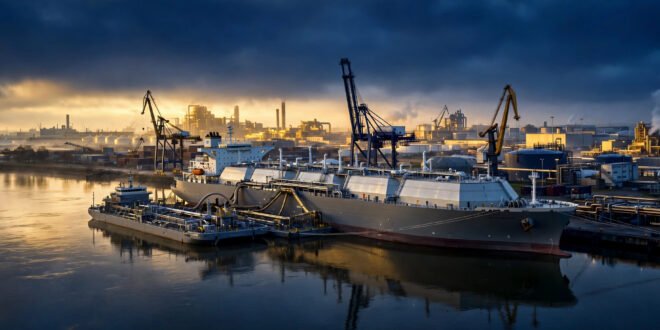
The Stade terminal is built around the Energos Force, a floating storage and regasification unit, or FSRU, a 294-metre vessel that receives liquefied natural gas from tankers, turns it back into gas, and feeds it into Germany’s pipeline network. The vessel has a tank capacity of 174,000 cubic metres, the largest of DET’s four FSRUs, and a maximum regasification capacity of about 750 million standard cubic feet of gas per day.
The terminal is at the Stade-Bützfleth industrial port in Lower Saxony, west of Hamburg on the Elbe. The Energos Force arrived there in mid-September 2026, and the first commissioning LNG cargo arrived on 2 November, when the tanker Lech Kaczyński unloaded 160,000 cubic metres of American gas from the Plaquemines terminal in Louisiana. That delivery marked the formal beginning of the terminal’s commissioning phase.
The terminal is connected to Germany’s long-distance gas network by a dedicated pipeline. Planned feed-in capacity is up to about 1.7 billion cubic metres for the rest of 2026, rising to 3.2 billion cubic metres a year in 2027, which DET says is enough gas for a year’s heating for about 2.6 million four-person households.
Why Germany Built Floating LNG Terminals
Germany built its floating LNG terminals after Russian pipeline deliveries were cut off in 2022. Before then, the country had no LNG import terminal at all, and it moved fast to charter FSRUs and build the jetties and pipelines to connect them. Stade is the fifth floating terminal to receive LNG by sea in Germany since 2022, and the fourth operated by DET, which already runs two in Wilhelmshaven and one in Brunsbüttel. A fifth, at Mukran, is operated by Deutsche Regas.
The floating terminals were always presented as a stopgap. They can be deployed quickly, but they are more expensive and less efficient than land-based terminals, and they depend on global LNG markets. At Stade, a separate, larger onshore import terminal is already under construction at the same site, designed to handle eventually more than double the floating terminal’s throughput, and the FSRU is expected to retire once that plant is finished.
The Stade project itself was repeatedly delayed. It was initially planned to be up and running in the first half of 2024, before project management disputes and unfinished terminal infrastructure pushed the schedule back. DET took over direct responsibility for the site at the end of 2025, and the September start originally announced for the FSRU slipped to early November.
What First Gas Means, and What It Does Not
First gas is the moment the terminal begins feeding gas into the grid, but it is not the end of commissioning. According to the commissioning plan published on the European gas infrastructure information platform, commissioning activities began on 6 November and are expected to run until mid-January 2027. The actual completion of gas delivery to the pipeline network remains subject to confirmation by the operator, and the schedule for feed-in is subject to the latest scheduling and facility testing results.
The volumes involved are also modest in the context of Germany’s total gas demand. At 3.2 billion cubic metres a year, Stade would cover only a small share of national consumption, and even the full fleet of floating terminals covers only part of what Russian pipeline gas once supplied. The terminal helps, but it does not solve the storage problem on its own.
Environmental groups have also raised concerns. The environmental group DUH has warned about dependence on US fracked gas, and the Stade cargo that arrived on 2 November came from Louisiana. Germany’s LNG imports are now heavily dependent on the United States, which has replaced Russia as the dominant supplier in a different form.
The Wider Energy Picture
Stade’s start-up comes on the same day that politicians, companies and the IG Metall union meet in Salzgitter for a national steel summit, and as the government weighs emergency coal legislation. The common thread is energy: German industry needs secure, affordable gas and electricity, and the government is under pressure to deliver both.
Gas storage is the immediate worry. Storage stood at 58 percent in mid-November, the lowest level since comparable records began in 2011, and the storage operators’ association INES has warned that an exceptionally cold winter could cause shortages as early as January. The Stade terminal adds supply, but storage is about stocks, not flows, and it will take time to rebuild.
The terminal also sits inside a larger debate about Germany’s energy future. The government is building LNG capacity, preparing a strategic gas reserve of about 24 terawatt-hours from 2027, and considering emergency coal legislation, all while trying to keep its climate targets intact. Stade is a piece of that puzzle, but it is not the whole answer.
What to Watch Next
The next milestone is confirmation that gas is flowing into the grid at the planned rate, and then the completion of commissioning by mid-January. DET will also be allocating capacity at the terminal and informing the market about auctions in due course, which will show how much demand there is from gas traders and suppliers.
The onshore terminal at Stade is the longer-term story. Once it is commissioned, targeted for 2027, with an announced capacity of 13.3 billion cubic metres a year, it will dwarf the floating unit. Until then, the Energos Force is the terminal, and its performance this winter will be watched closely.
For Germany, the first gas at Stade is a milestone worth noting, but it is also a reminder of how long energy infrastructure takes to build. Four years after the Russian gas cut-off, the country is still adding the pieces of its replacement supply system, one terminal at a time.
For more on energy supply routes and the risks around them, see our report on oil tankers and naval mines in the Strait of Hormuz.
Sources: TerraWorldNews, WeDoAny, Gas Processing & LNG.
Also visit our other websites: GulfCareers — Jobs in Dubai, UAE & Gulf | IndeedOne — Jobs and Information
