 EuroDaily News and Guidance, Every Day
Related Articles



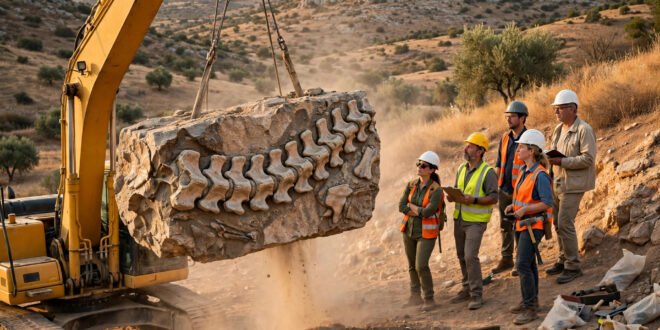
A Titanosaur discovery in Spain has drawn the attention of palaeontologists across Europe after researchers lifted an 18-tonne block of rock containing the neck of a giant sauropod from a site near Isona, in the Catalan province of Lleida. The neck alone measures up to seven metres long, and the team believes the animal could be the largest dinosaur yet found in Europe.
The fossil was extracted last Wednesday from the Molí del Piteu site in the Pallars Jussà comarca, in the foothills of the Pyrenees. The operation, carried out with heavy machinery, took about four hours. The block, roughly seven cubic metres of stone, also contains part of the chest, the forelimbs and the front of the body, and some vertebrae appear to remain in their original anatomical position, suggesting the carcass was not scattered after death some 70 million years ago.
Why This Titanosaur Discovery in Spain Matters
The excavation was led by specialists from the Museu de la Conca Dellà and the Institut Català de Paleontologia Miquel Crusafont. Àngel Galobart, the museum's director and an ICP researcher, explained that the ribs of the new specimen are longer than those of Abditosaurus, the titanosaur recovered from nearby Orcau in 2014, which measured between 15 and 18 metres from head to tail. If the neck proves complete, the Isona animal may have been larger still.
For comparison, the block lifted at Orcau in 2014 weighed five tonnes. The Molí del Piteu block weighs 18 tonnes, more than three times as much, underlining the scale of the animal. The team is also studying whether the bones belong to an entirely new species. The remains may be older than Abditosaurus, which was formally described in 2022 as the most complete titanosaur found in Europe and the largest known from the ancient Ibero-Armorican island.
The site itself was identified about five years ago, although excavations only began two years later. Bone fragments surfaced first, and as the dig progressed the team realised it was dealing with the remains of a genuinely large titanosaur. One setback came during last week's lift, when a fragment at the front of the block came loose during loading; specialists will now assess whether any bones were damaged.
Years of Laboratory Work Ahead
The next phase is slow and painstaking. Technicians in Isona will remove the rock surrounding the bones, clean each surface and study every element before the animal's true size and species can be confirmed. The researchers are deliberately cautious: they will not yet say whether this is the largest neck ever found, because that depends on how much of it survives inside the stone.
The restoration will be a public attraction in its own right. The Museu de la Conca Dellà plans to organise visits so that the public can follow the preparation work, and the finished remains are expected to go on display at the museum. The team hopes the process will be quicker than the years-long preparation of Abditosaurus.
A Valley Rich in Dinosaurs
The Conca Dellà is one of Europe's richest areas for late Cretaceous fossils, preserving the last dinosaurs that lived on the continent before the asteroid impact 66 million years ago. In the final chapter of the dinosaur era, this part of Europe was an island, the Ibero-Armorican island, and its titanosaurs evolved in isolation. That is precisely why each new specimen matters: the giants of this island do not fit the pattern of their mainland relatives, and some, like Abditosaurus, show unexpected links to species from South America and Africa.
Local museums have turned that heritage into a visitor economy. The Museu de la Conca Dellà in Isona already displays Abditosaurus and draws visitors to a network of sites across the valley, where fossilised footprints and eggs have also been found. A second, even bigger giant, prepared in public view, would strengthen the area's claim to be one of the essential stops for dinosaur science in Europe.
This Titanosaur discovery in Spain adds another giant to that record, and possibly the biggest of them all. The definitive answer now sits inside 18 tonnes of Pyrenean rock, waiting for the preparators' tools.
Also visit our other websites: GulfCareers — Jobs in Dubai, UAE & Gulf | IndeedOne — Jobs and Information
