EuroDaily News and Guidance, Every Day

Related Articles

Berlin Ukraine summit November 2026 ended with Europe's leaders pledging sustained support for Kyiv and calling on Russia to accept a winter energy ceasefire, hours after Presidents Donald Trump, Vladimir Putin and Xi Jinping held an unprecedented trilateral meeting in China that European capitals feared could sideline them.
A Show of Unity in Berlin
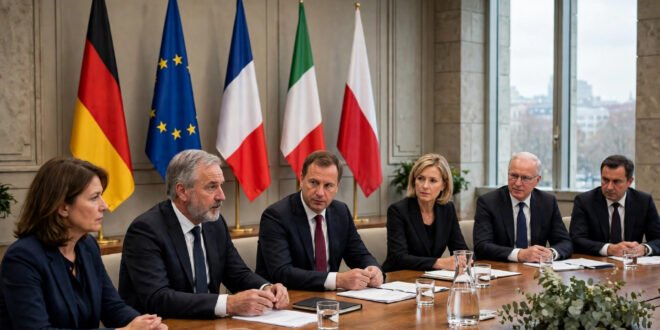
German Chancellor Friedrich Merz hosted the Coalition of the Willing summit at the Chancellery on Thursday, November 19. According to the German Chancellor's Office, 44 delegations attended, including 26 heads of state or government, alongside the leaders of the European Union and NATO. Ukrainian President Volodymyr Zelensky took a prominent role in the talks.
The coalition format, co-chaired by Germany, France and the United Kingdom, has existed since spring 2025 and now brings together almost 40 partner countries. US envoys Jared Kushner and Steve Witkoff also attended, and President Trump called into the meeting to update leaders on his conversations in Shenzhen.
A Call for a Winter Energy Truce
In a joint statement, the leaders of Germany, France, the United Kingdom and Ukraine called on Russia, as a first step towards a halt in hostilities, to agree to an energy ceasefire for the duration of the winter, and also to a ceasefire that would allow food exports through the Black Sea. The coalition restated its readiness to provide security guarantees for Ukraine after a peace settlement, to be closely coordinated with the United States.
Kushner said afterwards that Europe was very united and very strong in its support for Ukraine, and that Russia had agreed to engage in a multilateral format with the Europeans — a notable shift, since Moscow had earlier questioned the need for a European negotiating team.
Money for Kyiv
Financing Ukraine remains central to the talks. The European Commission put forward proposals on November 18 for further financial assistance of up to 45 billion euros for 2027, to sit alongside an already agreed support loan of 90 billion euros covering 2026 and 2027. Merz has continued to link German support for the EU's next long-term budget to all member states helping to finance Ukraine in 2027, a stance that Slovakia's Prime Minister Robert Fico has called blackmail. The loan proposal is expected to be discussed at an extraordinary EU summit in Brussels on November 26–27.
Shenzhen Looms Over the Summit
The Berlin meeting served as Europe's answer to Shenzhen, where Trump, Putin and Xi met for more than an hour and issued a joint "declaration for peace" calling for reform of the United Nations and curbs on the International Criminal Court. No concrete measures on Ukraine were agreed there.
European reactions were sharp. Merz criticised the Shenzhen format and dismissed the gathering as a "photo op", and he presented every other leader in Berlin with a piece of the Berlin Wall. Polish Prime Minister Donald Tusk said bluntly that "Putin is not and never will be our friend", while French President Emmanuel Macron said the world would not allow itself to be reordered from above and urged allies to reopen the question of Ukraine's NATO membership.
The War Continues
Even as leaders talked, the fighting went on. Russian drones struck Kyiv in daylight on Thursday, damaging the Dutch and Austrian embassies and shattering windows at St Volodymyr's Cathedral. The Netherlands summoned the Russian ambassador, with Foreign Minister Tom Berendsen calling the incident unacceptable. Putin, for his part, ruled out a ceasefire because of Ukraine's attacks on the Kerch bridge and promised a "painful" response.
Whether Berlin's show of unity translates into a European seat at the negotiating table will become clearer in the coming days, as the proposed multilateral talks involving Europe, the United States, Russia and Ukraine take shape.
Also visit our other websites: GulfCareers — Jobs in Dubai, UAE & Gulf | IndeedOne — Jobs and Information