EuroDaily News and Guidance, Every Day

Related Articles



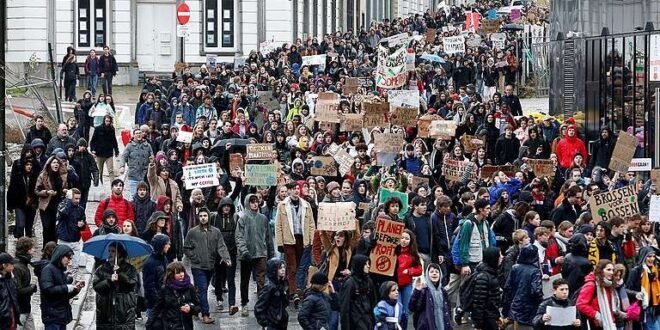
The Gen Z protests Europe witnessed this weekend were not one movement with one leader, but something harder for governments to answer: a shared mood arriving in dozens of cities at once. A coordinated international day of action on Friday 20 November brought students and young workers onto the streets in more than 25 countries, according to the Los Angeles Post, with demonstrations continuing in several cities on Saturday under the slogan "Fight for Our Future, Not Their Wars."
From London and Paris to Rome, Berlin and Madrid, the grievances rhymed even where the politics differed: the cost of living, tuition fees and underfunded schools, unaffordable housing, and the suspicion that governments can always find money for weapons but not for classrooms.
Five Strands, Not One Movement
Analysts who track European unrest describe the wave as several overlapping strands rather than a single campaign. An assessment by Northcott Global Solutions says protests that began in mid-September over deteriorating school conditions in France have since spread to 14 countries, and identifies distinct currents — an education revolt, housing movements in Spain and Portugal, union-backed strikes, and less organised copycat disorder, which it notes tends to be the most violent.
The pattern was visible this weekend. In Germany, reporting cited by analysts described the "Gen Z regelt" alliance bringing more than 100,000 people into over 30 cities on 31 October in largely orderly marches. In Belgium, by contrast, protests over university fees produced 194 arrests in Liège in a single week. In Spain, anger over rents and evictions — sharpened by the death of an evicted 87-year-old woman — has fed marches of tens of thousands and forms part of the backdrop to the snap election on 29 November.
The Argument Over Guns and Classrooms
The sharpest common thread is spending priorities. Protesters in Germany, Italy and Britain voiced concerns about conscription and rising military spending alongside underfunded public services, according to the Los Angeles Post. "Young people will not sit quietly while our schools, colleges and universities are cut and billions are found for war," the national chair of Britain's Socialist Students, Adam Powell-Davies, said in a statement.
In Italy, the country's largest union, the CGIL, joined the day of action with demonstrations in more than 100 squares; its leader, Maurizio Landini, claimed more than a million people took part nationwide, a figure that could not be independently confirmed. In Britain, students from more than 350 schools, colleges and universities were expected to walk out, according to one of the groups involved.
Why Governments Struggle to Respond
A protest cycle with many causes offers no single concession that can end it. Cheaper energy does not fix rents in Lisbon; more teachers in France do not answer fears of conscription in the Netherlands, where students also walked out in 16 cities on Friday. What unites the strands is generational: a cohort shaped by the pandemic, inflation and wars in Ukraine and Gaza, which now doubts that the future on offer — expensive housing, insecure work, strained services — is the one it was promised.
Risk analysts expect the unrest risk to stay elevated through December, with France as the epicentre. The political calendar will keep the pressure on: France votes for a president in April, Spain votes this Sunday, and budgets across the continent are being written now. Whether this weekend becomes a peak or a beginning depends less on the streets than on whether those budgets visibly change the priorities young Europeans are marching against.
Also visit our other websites: GulfCareers — Jobs in Dubai, UAE & Gulf | IndeedOne — Jobs and Information