EuroDaily News and Guidance, Every Day
Related Articles



Spain has declared a migration emergency in the Canary Islands after a record day of arrivals on the Atlantic route from West Africa. The Canary Islands migrant arrivals record was broken on Saturday 14 November 2026, when Spain’s Maritime Rescue Service brought 1,488 people ashore in a single day, the highest daily total since records began 32 years ago. More than 9,000 people have reached the archipelago by sea since the start of November.
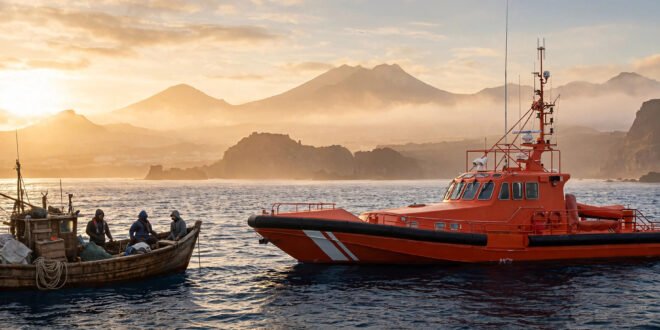
The 1,488 people arrived aboard 14 wooden fishing boats known as pirogues, most of them landing on El Hierro, the smallest and westernmost of the Canary Islands. The previous daily record, 1,461 people rescued on 7 November 2020, had stood for six years. Nearly 2,200 migrants reached the islands over the two days of the weekend, according to Spain’s maritime rescue service, and arrivals were still continuing on Sunday afternoon.
The surge has strained reception and emergency services, particularly on the smaller islands. El Hierro has about 12,000 inhabitants, and the arrival of hundreds of people in a single day overwhelms its port, its medical services and its reception centre. Spain’s Territorial Policy Minister, Ángel Víctor Torres, visited El Hierro on Sunday to discuss the surge, as the government faced a migration crisis in the middle of a general election campaign.
The Record Day: 14 Boats and 1,488 People
The rescue service’s figures tell the story of the day. Fourteen boats were intercepted and escorted to shore, most of them to La Restinga, the port on the southern tip of El Hierro. The people on board came mostly from Senegal, The Gambia and Guinea, according to the authorities, and had crossed from the West African coast in overcrowded wooden vessels.
One boat alone was carrying 240 people, including 12 women and 36 children, the authorities said. Footage from La Restinga showed the brightly painted wooden boats approaching the port, migrants being helped ashore by rescue workers in high-visibility vests and Red Cross personnel, and large groups of arrivals wrapped in red thermal blankets gathered behind fencing at a reception area. Some were barefoot; one man was seen kneeling and touching the ground after landing.
Al Jazeera’s Bernard Smith, reporting from El Hierro, said the arrival had set a record in the 32 years since statistics have been collected. “There’s been even more arrivals by Sunday afternoon,” he said, adding that the new arrivals are processed at the port in El Hierro and taken to a reception centre, then sent on to other Canary Islands or to the Spanish mainland.
A Deadly Crossing from West Africa
The Atlantic route from West Africa to the Canary Islands is one of the world’s deadliest migration crossings. The International Organization for Migration recorded at least 450 deaths on the route in the first 10 months of 2026, and the true figure is likely to be higher, because many boats disappear without trace and their passengers are never counted.
The crossing is made in wooden fishing vessels called pirogues, in which up to 100 people are packed for a journey that can last a week. Al Jazeera’s Nicolas Haque, reporting from Dakar in Senegal, from where some of the boats depart, said favourable weather conditions in the Atlantic had made departures easier in recent years. “So when the weather conditions allow it, the boats go out there,” he said.
Most of the migrants arriving in El Hierro depart from West Africa, many leaving from Senegal, with hopes of reaching mainland Europe. The Canary Islands are the first European land they reach, but they are more than 1,000 kilometres from the Spanish mainland, and the onward journey depends on the Spanish authorities transferring them to reception centres elsewhere in Spain.
Why the Numbers Have Surged in November
Arrivals were down 5.5 per cent year to date before the surge, according to reports of the weekend, which makes the November spike all the more striking. More than 9,000 people arrived in the first two weeks of November alone, and the sharp October surge had already strained reception services on the smaller islands before the record weekend.
Several factors are reported to be behind the increase. The weather in the Atlantic has been favourable for crossings, and authorities had received prior warnings about increased departures from West Africa. The route has also become more attractive as other routes into Europe have been closed or made harder, and the networks that organise the crossings have adapted to enforcement on land and at sea.
The surge comes months after the European Union’s new Pact on Migration and Asylum took effect on 12 June 2026, setting common rules for handling asylum requests in what was described as the most sweeping overhaul of EU asylum and border law in decades. Al Jazeera’s reporting notes that the new rules have not stopped the flow of migrants to Spain and its territories, and its correspondent in El Hierro said EU states are under pressure to do more to control migration from Africa and from outside the European Union.
The Emergency Response on El Hierro
Spain’s declaration of a migration emergency in the Canary Islands is a recognition that the normal reception system cannot cope with the numbers. On El Hierro, the Red Cross emergency unit has been working to keep services running despite the volume. Dácil M. León Hernández, the head of the unit, said in a report on the weekend that the teams try to ensure the service does not falter, even as boat after boat arrives.
Local people have felt the strain directly. Fernando Gutiérrez, a fisherman on El Hierro, described the situation as a real disaster that is hard to understand for those not living there, in a report by France 24. Buses have been used to move arrivals from the port to reception facilities, and medical staff, Guardia Civil officers and Red Cross workers have been deployed in numbers the small island rarely sees.
The minister’s visit on Sunday was meant to show that the government is responding, but the emergency declaration does not by itself solve the problem. The arrivals must be processed, housed and moved onward, and the smaller islands have limited capacity to do any of that at the pace the boats are arriving.
Migration and the Spanish Election
The surge has arrived in the middle of Spain’s snap election campaign, and migration is one of the issues dominating it. The general election is on 29 November, and the polls put the conservative People’s Party ahead of Prime Minister Pedro Sánchez’s Socialists, with the right-wing Vox party needed for a majority. Both the PP and Vox have campaigned on tighter borders, and the Canary Islands arrivals have given that message fresh force.
Sánchez has called migration a key issue for voters, and the government’s handling of the Canary Islands surge will be judged in that light. The emergency declaration shows the government recognises the scale of the problem, but the opposition will argue that the numbers themselves show the policy has failed. The record weekend, coming two weeks before polling day, ensures the argument will run until the vote.
For now, the facts are the numbers: 1,488 people in a single day, 14 boats, nearly 2,200 over two days, and more than 9,000 since the start of November. Behind them are the 450 deaths recorded on the route this year, and the boats that are still coming while the weather holds.
For context on how another country is handling migration enforcement, see our report on Trump’s deportation policy.
Sources: Al Jazeera, Al Jazeera Newsfeed, PJM TV, from Al Jazeera, AP and Reuters.
Also visit our other websites: GulfCareers — Jobs in Dubai, UAE & Gulf | IndeedOne — Jobs and Information